
Table of contents
- What Is a Bearer Instrument?
- A Short History of Bearer Instruments
- The Ancient World
- Medieval Bills of Exchange
- The Bearer Bond Era (1800s-1900s)
- Cash: The Most Successful Bearer Instrument
- The Decline of Bearer Instruments
- Why Bearer Instruments Matter
- No Counterparty Risk
- Transaction Finality
- Financial Inclusion
- Privacy
- Censorship Resistance
- Bitcoin: The Digital Bearer Instrument
- The Bitcoin ATM: Where Bearer Meets Bearer
- The Regulatory Tension
- Frequently Asked Questions
- What is a bearer instrument?
- Is Bitcoin a bearer instrument?
- Why do bearer instruments matter?
- How does a Bitcoin ATM preserve the bearer property?
- Are bearer instruments legal?
What Is a Bearer Instrument?
A bearer instrument is any asset where possession equals ownership. No registry. No intermediary. No permission needed. If you hold it, you own it -- and you can transfer it to anyone, at any time, without asking a third party for approval.
The simplest example is a $20 bill. Whoever holds it, owns it. No bank needs to verify the transaction. No ledger needs updating. No app needs to be online. The physical possession of the note is the proof of ownership. Hand it to someone, and it's theirs. That's it. The transaction is complete.
Other historical examples abound: gold coins, bearer bonds, physical stock certificates, cashier's checks, postage stamps, casino chips. What unites them is a single defining property: "If you have it, it's yours." There is no counterparty risk -- no custodian who can freeze your asset, no institution that can decline your transfer, no database that needs to agree with reality. The asset and the ownership are the same thing.
This seems almost trivially obvious when you think about physical objects. Of course you own the gold coin in your pocket. But in a world that increasingly runs on digital ledgers, registered accounts, and permissioned transactions, the bearer property has become remarkably rare -- and remarkably valuable.
A Short History of Bearer Instruments
The Ancient World
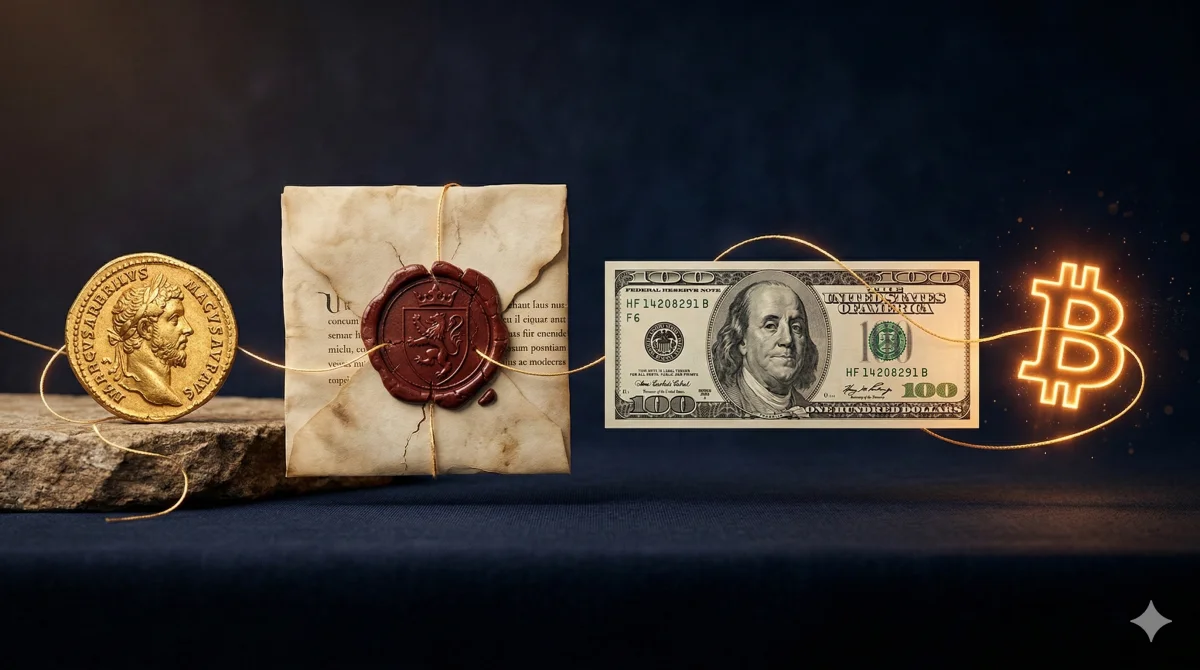
Gold and silver coins were the original bearer instruments. For thousands of years, they were the backbone of commerce across civilizations that shared no common language, no common law, and no common institutions. A gold coin minted in Rome had value in Carthage, in Persia, in the markets of the Silk Road -- not because any government vouched for it across borders, but because the metal itself was the value. The coin was its own credential.
Roman soldiers were paid in physical coins (the word "salary" derives from salarium, connected to salt -- another bearer commodity that functioned as money). Trade across empires worked precisely because bearer instruments needed no institutional trust. A merchant in Alexandria didn't need to verify a Roman's bank balance. The gold spoke for itself.
Medieval Bills of Exchange
As trade routes grew longer and more dangerous, carrying physical gold became impractical and perilous. Early banking innovations created bearer notes -- paper promises that could be traded hand to hand without the original parties. The Medici Bank, Venetian merchants, and the great trading houses of the Italian Renaissance developed bills of exchange that functioned as portable bearer instruments. A note written in Florence could be presented in London. The bearer of the note was the owner of the claim.
These instruments represented an elegant abstraction: the value of gold, without the weight. But they preserved the core bearer property -- whoever held the paper held the claim. No registration was required to transfer them.
The Bearer Bond Era (1800s-1900s)
Governments and corporations took this concept to its logical conclusion with bearer bonds. These were debt instruments where the physical certificate was the claim. No registration. No name on file. You clipped the coupon attached to the bond, presented it, and collected your interest payment. You sold the bond by handing it to someone.
Bearer bonds were enormously popular -- and enormously easy to abuse. They became the instrument of choice for tax evasion, money laundering, and bribery precisely because they left no ownership trail. A briefcase of bearer bonds was as anonymous as a briefcase of cash, but far more compact and valuable.
The United States effectively banned domestic bearer bonds in 1982 with the Tax Equity and Fiscal Responsibility Act (TEFRA), which stripped the tax deduction for interest paid on bearer instruments. The message was clear: the government wanted every financial claim to have a name attached to it.
Cash: The Most Successful Bearer Instrument
Physical currency remains the most successful bearer instrument in human history. Despite decades of predictions about its demise, cash still accounts for roughly 20% of U.S. transactions. Globally, the figures are even higher.
Why does cash persist in an age of contactless payments and mobile wallets? Because it offers something no digital payment system can match: it is instant, final, private, and requires zero technology or permission. No app crashes. No declined cards. No "your account has been temporarily frozen while we review suspicious activity." Cash just works -- for everyone, everywhere, every time.
The Decline of Bearer Instruments
Since the 1970s, governments worldwide have been systematically eliminating bearer instruments from the financial system. Bearer bonds were banned. Large cash transactions became subject to mandatory reporting (Currency Transaction Reports for amounts over $10,000 in the U.S.). Suspicious Activity Reports (SARs) created a dragnet of financial surveillance.
India demonetized 86% of its currency overnight in 2016, forcing citizens to deposit their cash in banks -- effectively converting bearer instruments into registered, monitored accounts. The European Union eliminated the 500-euro note. Governments from Sweden to China have pushed aggressively toward cashless economies.
The trend is unmistakable: institutions want every transaction to flow through registered, monitored, permissioned channels. The bearer instrument -- the oldest form of property in human civilization -- is being engineered out of existence.
Why Bearer Instruments Matter
No Counterparty Risk
If you hold cash or gold, no bank failure can take it from you. When Lehman Brothers collapsed in 2008 and the global financial system teetered on the edge, people with bearer assets -- cash under the mattress, gold in a safe -- were fine. People with money in institutional accounts watched helplessly as counterparty risk cascaded through the system. Bearer instruments eliminate the middleman, and with it, the risk that the middleman fails.
Transaction Finality
When you hand someone a $100 bill, the transaction is done. There are no chargebacks. No reversals. No "pending" status for 3-5 business days. No compliance department reviewing whether your purchase is consistent with your spending patterns. The finality of bearer transactions is enormously valuable in commerce -- it is why cash transactions cost merchants nothing in payment processing fees, why they settle instantly, and why they never result in disputed charges.
Financial Inclusion
According to Federal Reserve data, approximately 24.6 million American adults are unbanked -- they have no checking account, no savings account, no relationship with the traditional financial system. For these people, bearer instruments are not a preference. They are the only money that works. No credit check. No minimum balance. No monthly maintenance fees. No identification requirements for small transactions. Cash is the most inclusive financial technology ever invented, precisely because it is a bearer instrument.
Privacy
Privacy is not secrecy. The difference is the same as the difference between your neighbor knowing your salary and not knowing your salary. You are not hiding anything criminal by keeping your financial life private -- you are exercising a basic human right that every generation before the digital age took for granted.
Bearer transactions do not create permanent digital trails that can be hacked, sold to data brokers, subpoenaed by overreaching authorities, or correlated with your other digital activity. In an era when data breaches expose millions of financial records annually, the privacy properties of bearer instruments are not a relic -- they are an underappreciated feature.
Censorship Resistance
No one can freeze a $20 bill. In countries with authoritarian governments, bearer instruments are often the only way people can store and transfer value without state interference. Dissidents, journalists, and political opposition movements have relied on cash and gold for centuries precisely because these assets cannot be confiscated through a database query.
This matters even in democracies. In 2022, the Canadian government invoked emergency powers to freeze bank accounts of people associated with the trucker convoy protests -- without criminal charges, without court orders, through direct instructions to financial institutions. Whatever one thinks of those protests, the precedent is sobering: in a fully registered financial system, the government can cut you off from your own money with a phone call.
Bitcoin: The Digital Bearer Instrument
For decades, a digital bearer instrument seemed like a contradiction in terms. Digital information can be copied. If I email you a photo, I still have the photo. So how can a digital asset have the bearer property -- where transferring it to you means I no longer have it?
This was the "double-spend problem," and every digital payment system before Bitcoin solved it the same way: by introducing a trusted intermediary to keep the ledger. PayPal, Venmo, your bank's online portal -- they all work because a central authority tracks who owns what. Digital meant registered. Digital meant custodial. Digital meant permissioned.
Bitcoin changed that. Through a combination of public-key cryptography, a distributed ledger, and proof-of-work consensus, Bitcoin created something that had never existed before: a digital asset that behaves like a bearer instrument. If you hold your private keys, you hold your bitcoin. No exchange, no bank, no government can move it without your cryptographic authorization. Possession of the key is ownership of the asset. That is the bearer property, translated into the digital realm.
Unlike physical bearer instruments, Bitcoin cannot be physically stolen from a safe (without the private keys), forged, or counterfeited. The supply is mathematically fixed at 21 million. Unlike cash, it can be transmitted across the globe in minutes, crossing borders without customs agents, intermediaries, or wire transfer fees.
The tradeoff is real: Bitcoin's ledger is public (pseudonymous, not anonymous), and self-custody requires technical competence that not everyone possesses today. But the core property -- no intermediary required for ownership or transfer -- is preserved. For the first time in history, you can hold a digital asset the way you hold a gold coin: directly, without permission, without a custodian who can say no.
The Bitcoin ATM: Where Bearer Meets Bearer
This is where the history of money gets interesting. A Bitcoin ATM is the bridge between the physical bearer world and the digital bearer world. It is the point where the oldest form of money meets the newest.
Cash in, Bitcoin out. You walk up to the machine with a bearer instrument -- physical cash -- and you walk away with a bearer instrument -- bitcoin held in your self-custody wallet. No bank account required. No exchange account required. No custodial relationship created.
This is fundamentally different from buying Bitcoin on Coinbase, Kraken, or Cash App. Those are registered, custodial transactions. The exchange holds your bitcoin on your behalf. They can freeze your account, delay your withdrawal, report your activity, or shut you out entirely. When your bitcoin sits on an exchange, you do not actually hold a bearer instrument -- you hold an IOU from a company. And as the Mt. Gox and FTX collapses demonstrated, IOUs from companies can become worthless overnight.
At a Bitcoin ATM, the transaction works differently. You scan your wallet -- your keys, your address. You insert your cash. Bitcoin arrives in your wallet. Bearer to bearer. The machine is just the bridge -- a protocol translator between two bearer systems that happen to exist in different physical domains.
Why do people love this? Because it has the same directness as handing someone cash. No accounts to open. No three-day waiting periods while your bank transfer clears. No custodial shenanigans where your withdrawal is "under review." You walked in with value you controlled, and you walked out with value you control. The form changed. The bearer property did not.
For a detailed walkthrough of the process, see our guide to using Bitcoin ATMs.
Byte Federal operates 1,350+ of these bridges across 42 states. Each one is a point where the oldest form of money -- physical cash, a bearer instrument with thousands of years of history -- meets the newest: a digital bearer asset built on cryptographic proof rather than institutional trust.
The Regulatory Tension
Governments have spent five decades systematically eliminating bearer instruments from the financial system. Cash reporting requirements, SAR filings, the death of bearer bonds, the push toward cashless economies -- the policy direction is consistent and unmistakable. Institutions want visibility into every financial transaction. Bearer instruments, by their nature, resist that visibility.
Bitcoin ATMs sit at the uncomfortable intersection of this trend. They facilitate bearer-to-bearer transfers -- exactly the kind of transaction that the regulatory apparatus is designed to eliminate. This is why Bitcoin ATMs face some of the strictest compliance requirements in all of financial services: Know Your Customer (KYC) verification, Anti-Money Laundering (AML) programs, state-by-state money transmitter licensing, FinCEN registration, surety bonds, and ongoing transaction monitoring.
The irony is sharp: Bitcoin ATMs are arguably the most regulated way to acquire a bearer asset. Far more regulated than buying gold coins at a coin shop. Far more regulated than receiving a cash payment for freelance work. Far more regulated than inheriting a safe deposit box full of valuables. The industry's response to regulatory pressure has been to embrace compliance while preserving the bearer property for the end user -- to build the most transparent bridge possible between two systems that are, by design, opaque.
For more on how this regulatory tension plays out in practice, see our fraud prevention research.
The deeper question is one for society, not just for regulators: Do we want a world where all money flows through permissioned channels? Where every transaction is monitored, every account can be frozen, every payment requires institutional approval? Where a government can cut a citizen off from the financial system without a trial? Or is there value -- real, lasting, civilizational value -- in preserving the ability for individuals to hold and transfer value directly, bearer to bearer, as humans have done for thousands of years?
The answer to that question will shape the financial system for generations. Bearer instruments are not a loophole. They are not an anachronism. They are a feature of a free society -- one that Bitcoin, and the ATMs that connect it to the physical world, are working to preserve in digital form.
Frequently Asked Questions
What is a bearer instrument?
A bearer instrument is any asset where physical possession equals ownership. Cash, gold coins, and Bitcoin (in self-custody) are all bearer instruments. No intermediary, registry, or third-party verification is needed to prove you own it. If you hold it, it's yours.
Is Bitcoin a bearer instrument?
Yes, when held in self-custody -- meaning you control your own private keys in your own wallet. If your Bitcoin sits on an exchange like Coinbase or Kraken, it is not a bearer instrument. In that case, the exchange is the custodian, and you hold a claim against the company rather than the asset itself. For more on this distinction, see our guide to self-custody vs. custodial solutions.
Why do bearer instruments matter?
Bearer instruments provide transaction finality (no chargebacks or reversals), financial inclusion (no bank account required), privacy (no permanent digital trail), freedom from counterparty risk (no custodian who can fail or freeze your assets), and censorship resistance (no institution can block your use of your own money). They are the only form of money that works without institutional permission.
How does a Bitcoin ATM preserve the bearer property?
At a Bitcoin ATM, you insert cash (a physical bearer instrument) and receive Bitcoin directly into your own self-custody wallet (a digital bearer instrument). No exchange account is created. No custodial relationship is established. You walked in controlling your value, and you walk out controlling your value. The machine is simply a bridge between the physical and digital bearer worlds.
Are bearer instruments legal?
Cash, gold, and Bitcoin are all legal bearer instruments in the United States and most other jurisdictions. Some former bearer instruments -- such as U.S. bearer bonds -- were restricted by legislation (TEFRA, 1982), but the concept of bearer ownership is fundamental to commerce and property rights. Holding value directly, without a custodian, is not only legal but is the default mode of property ownership throughout most of human history.
Ready to make the bridge from cash to crypto? Find your nearest Byte Federal ATM and experience bearer-to-bearer transfer for yourself.
Frequently asked questions
What is a bearer instrument?
A bearer instrument is any asset where physical possession equals ownership. Cash, gold coins, and Bitcoin (in self-custody) are bearer instruments. No intermediary or registry is needed to prove you own it.
Is Bitcoin a bearer instrument?
Yes, when held in self-custody (your own wallet with your own private keys). If your Bitcoin is on an exchange, it is not a bearer instrument -- the exchange is the custodian.
Why do bearer instruments matter?
They provide transaction finality, financial inclusion, privacy, and freedom from counterparty risk. They are the only form of money that works without institutional permission.
How does a Bitcoin ATM preserve the bearer property?
You insert cash (a physical bearer instrument) and receive Bitcoin directly into your self-custody wallet (a digital bearer instrument). No exchange account or custodial relationship is created.
Are bearer instruments legal?
Cash, gold, and Bitcoin are all legal bearer instruments. Some former bearer instruments (like US bearer bonds) were restricted by legislation, but the concept itself is fundamental to commerce and property rights.
Topics in this guide
- bearer-instruments
- cash-to-crypto
- financial-history
- self-custody
Use what you learned
Choose the Byte Federal product that fits your next step.