

Table of contents
- Check a pending bitcoin transaction in five steps
- Know what unconfirmed and six confirmations mean
- Plan on about an hour, unless the fee is low
- Speed it up by raising the fee
- If it never confirms, the coins stay with the sender
- Track a Bitcoin ATM purchase with the receipt
- Wait, bump the fee or get help
- Sources
Until a pending bitcoin transaction lands in a block, the coins have not arrived, and a low fee can leave it waiting until the network drops it.
The coins are not lost either way. The block explorer mempool.space says in its FAQ that “a Bitcoin transaction will always either confirm completely (or not at all) at some point,” and if yours drops out, the coins are still in the sending wallet or account.
The transaction ID shows in a few minutes whether to wait, push for a higher fee or contact whoever sent the coins.
Check a pending bitcoin transaction in five steps
You need the transaction ID, often labeled TXID or hash, from your wallet’s history, the exchange’s withdrawal record or a Bitcoin ATM receipt. The steps use mempool.space, a block explorer that shows blocks, transactions and addresses as they happen.
- Copy the transaction ID.
- Paste it into the search box at the top right of mempool.space. If you have no ID, search the receiving address instead.
- Read the status. Unconfirmed means it is still waiting; confirmed means it is in a block.
- Find the fee rate on the transaction’s page, shown in sat/vB, and compare it with the fee estimates on the site’s front page.
- If the explorer finds nothing, the coins may not have been sent yet. After an exchange withdrawal, that means the exchange has not broadcast it, a CoinGuides explainer says, so ask the exchange’s support.
Know what unconfirmed and six confirmations mean
Unconfirmed means the transaction is waiting in the mempool, short for “memory pool,” the line each computer on the network, or node, keeps of transactions not yet in a block. There is no single mempool, mempool.space says, so different nodes may hold different transactions.
A confirmation is a block. Once your transaction is in one, it has one confirmation, and each block after it buries it deeper and lowers the risk of a reversal, according to the Bitcoin.org FAQ.
Each wallet, exchange or merchant decides how many confirmations it needs. Bitcoin.org says six “is often considered to be as safe as waiting 6 months on a credit card transaction.”
Plan on about an hour, unless the fee is low
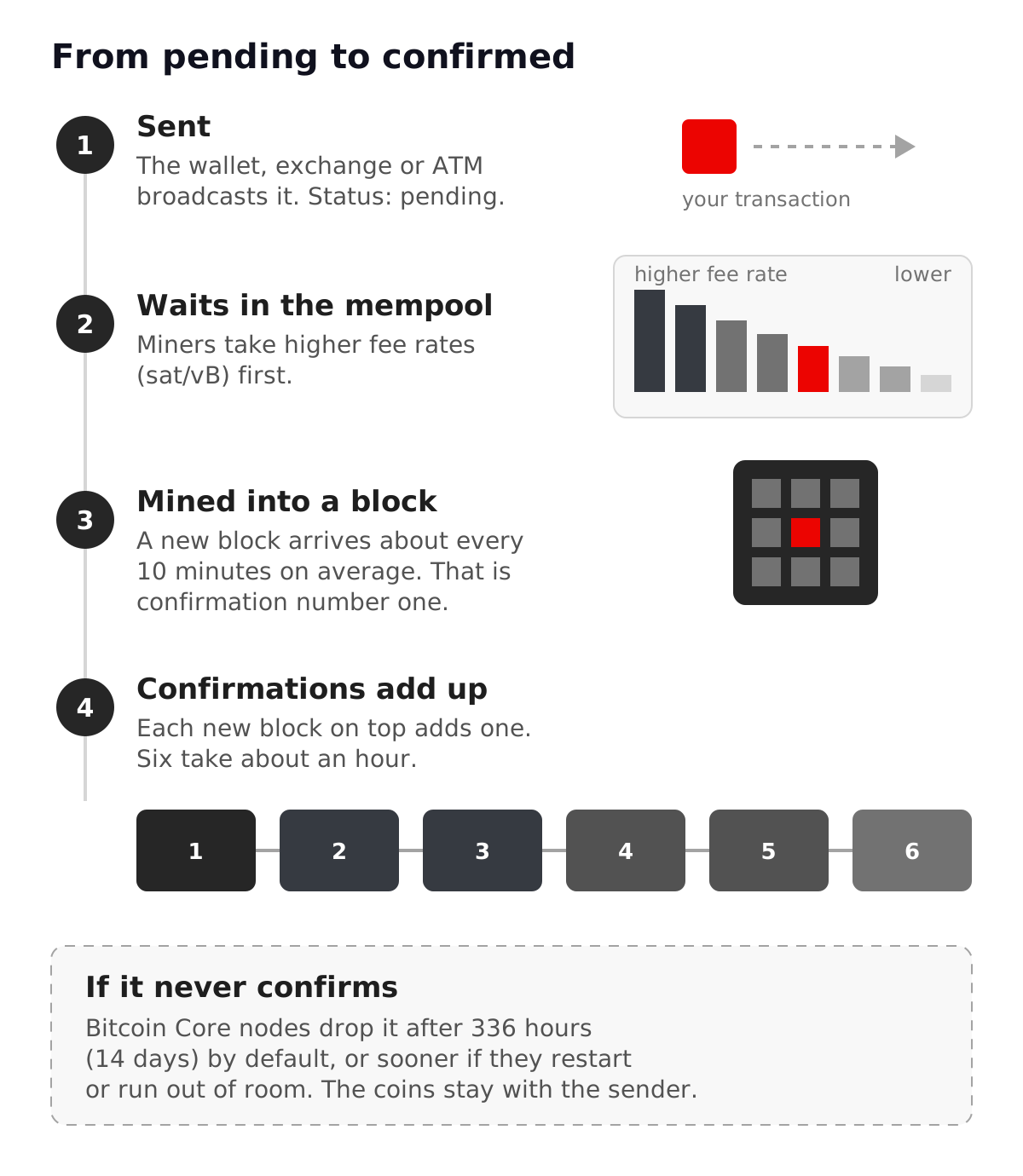
New blocks arrive about every 10 minutes on average, the Bitcoin.org FAQ says, so six confirmations take roughly an hour. Block timing is random, though, and any one confirmation can come much sooner or much later.
The fee rate decides most of the wait for the first one. Miners favor transactions that pay more per unit of block space, measured in satoshis per virtual byte, or sat/vB.

If yours pays less than the network is prioritizing, the first confirmation can take considerably longer, Bitcoin.org says.
A busy network raises the bar. Once a node fills the 300 MB that Bitcoin Core sets aside for its mempool by default, it turns away new transactions below a certain fee rate, according to mempool.space.
Speed it up by raising the fee
Only a higher effective fee rate speeds up a stuck transaction, mempool.space says. Both ways to raise it need a wallet that supports them.
Replace-by-fee, or RBF, lets the sender broadcast a new version that spends the same coins with a higher fee. Bitcoin Core nodes have accepted those replacements by default since version 28.0, published Oct. 2, 2024.
Child pays for parent, or CPFP, works from the other end. Whoever controls one of the stuck transaction’s outputs, often the person receiving the coins, spends it in a new transaction with a fee high enough that miners take both.
If you’re not sure how, mempool.space says to work with the wallet or exchange that made the transaction. ByteU’s Bitcoin Transaction Fees Explained (2026) walks through both methods.
If it never confirms, the coins stay with the sender
The transaction drops out of the network’s mempools, and the coins are still in the sending wallet or account. Bitcoin.com’s support center says a broadcast transaction that no miner picks up is canceled automatically and the funds return to the sender’s wallet.
Nodes running Bitcoin Core on its default settings keep an unconfirmed transaction for at most 336 hours, or 14 days. That is the default in version 32.1, published Oct. 27, 2026.
It can drop out much sooner. Bitcoin Core keeps unconfirmed transactions only in memory, so a node loses them when it restarts or purges low-fee transactions to make room in a full mempool, and never-mined transactions “tend to slowly disappear from the network,” the Bitcoin developer guide says.
Before anyone sends the payment again, wait until the sender’s wallet shows the coins as spendable. If the first transaction confirms after all, CoinGuides warns, you pay twice.
Track a Bitcoin ATM purchase with the receipt
A Bitcoin ATM purchase travels the network as an ordinary on-chain transaction to the wallet address you scanned, so the same block and fee rules apply.
Byte Federal operates Bitcoin ATMs. Its ATM guide says the machine broadcasts the transaction and prints a receipt with “the transaction ID (TXID) for tracking on blockchain explorers.”
The guide lists a low-priority fee set by the ATM as one reason a purchase can be slow, and tells buyers to contact Byte Federal support with the receipt if the transaction doesn’t appear after 24 hours.
Keep the receipt. If it shows a transaction ID, that is what you paste into the explorer.
Wait, bump the fee or get help
Match what the explorer shows to the next step.
- Unconfirmed, fee rate close to current estimates: wait. Higher-paying transactions go first.
- Unconfirmed, fee rate far below the estimates: ask the sender to bump the fee with RBF, or use CPFP if your wallet supports it.
- Not found, or no transaction ID: the coins were probably not sent. Contact the exchange, wallet provider or ATM operator.
- Gone after days unconfirmed: it was likely dropped. Ask the sender to confirm the coins are back before sending again.
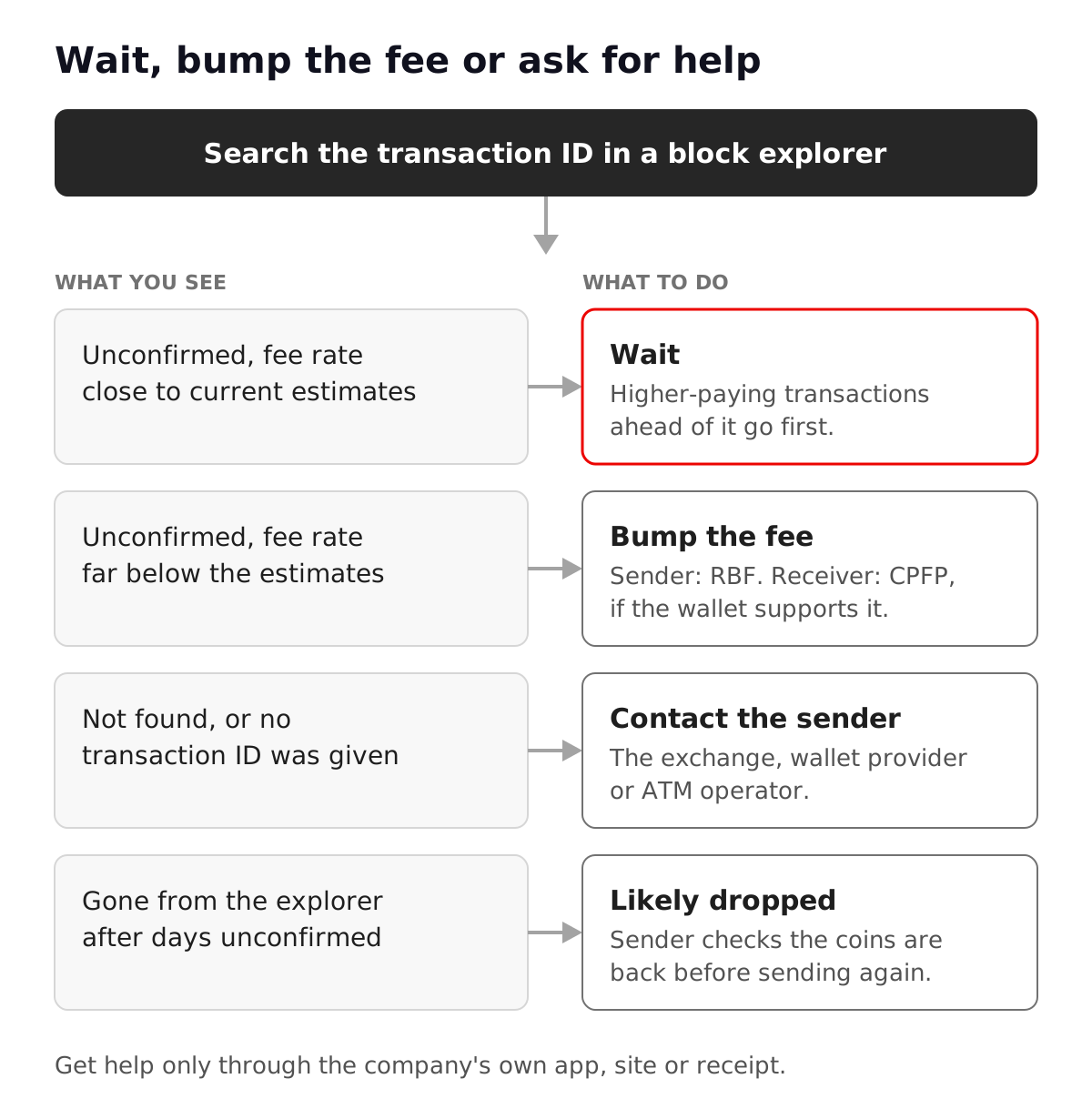
Help comes from “the entity that helped make the transaction,” mempool.space says, because an explorer only shows network data. Reach that company through its own app, website or receipt, never through someone who messages you first offering to fix the payment.
The Federal Trade Commission says “No legitimate business or government will ever email, text, or message you on social media to ask for money,” and that cryptocurrency payments typically are not reversible once sent. Report crypto fraud to the FTC at ReportFraud.ftc.gov.
Some images in this article were generated with AI.
This article is for educational purposes only and is not financial advice.
Sources
- Bitcoin.org, Frequently Asked Questions, accessed Nov. 5, 2026.
- Bitcoin developer guide, P2P Network: Memory Pool, accessed Nov. 5, 2026.
- mempool.space, FAQ, accessed Nov. 5, 2026.
- Bitcoin Core, source code at release v32.1, mempool options, accessed Nov. 5, 2026.
- Bitcoin Core, Bitcoin Core 32.1 release notes, Oct. 27, 2026.
- Bitcoin Core, Bitcoin Core 28.0 release notes, Oct. 2, 2024.
- Bitcoin.com Support Center, Pending Transactions (BTC), accessed Nov. 5, 2026.
- CoinGuides, Why Is My Crypto Transaction Pending? (And What to Do), accessed Nov. 5, 2026.
- Federal Trade Commission, What To Know About Cryptocurrency and Scams, accessed Nov. 5, 2026.
- Byte Federal, How to Use a Bitcoin ATM (2026 Guide), accessed Nov. 5, 2026.
Frequently asked questions
Is my bitcoin lost if a transaction is stuck on pending?
No. mempool.space says a bitcoin transaction either confirms completely or not at all. If it never confirms, nodes drop it, and Bitcoin.com's support center says the funds return to the sender's wallet. Wait until the sender sees them as spendable again before anyone resends the payment.
How long can a bitcoin transaction stay pending?
Until a miner puts it in a block or the network drops it. Bitcoin Core nodes keep an unconfirmed transaction for at most 336 hours, or 14 days, by default, and can let it go sooner when they restart or run short of space. A dropped transaction leaves the coins with the sender.
How many confirmations does a bitcoin transaction need?
Each wallet, exchange or merchant sets its own number. Bitcoin.org says six confirmations is often treated as being as safe as waiting six months on a credit card payment. At the 10-minute average between blocks, six confirmations take about an hour.
Can I cancel a pending bitcoin transaction?
Not directly. The sender can replace it with a higher-fee version that spends the same coins, called replace-by-fee, which Bitcoin Core nodes accept by default since version 28.0. If it is never mined, nodes drop it and the coins stay spendable by the sender.
Why does a block explorer say my transaction is unconfirmed?
It has been broadcast but is not in a block yet. It waits in the mempool, where miners favor transactions that pay a higher fee rate in sat/vB. If yours pays less than what is confirming now, it waits longer, more so when the network is busy.
How long does a Bitcoin ATM purchase take to show up?
The ATM sends an ordinary on-chain transaction, so the usual block and fee timing applies. Search the transaction ID from your receipt in a block explorer, and contact the ATM operator with the receipt if the explorer cannot find it.
Topics in this guide
- transactions
- mempool
- fees
- atm
Use what you learned
Choose the Byte Federal product that fits your next step.