

You get a text from a stranger with the wrong number. You reply to be polite. Over time, a trading app shows your balance climbing, and the only thing between you and a withdrawal is a “tax” you have to pay first.
None of it is real. Americans reported losing $7.2 billion to crypto investment fraud in 2025, more than to any other crime reported to the FBI’s Internet Crime Complaint Center, or IC3.
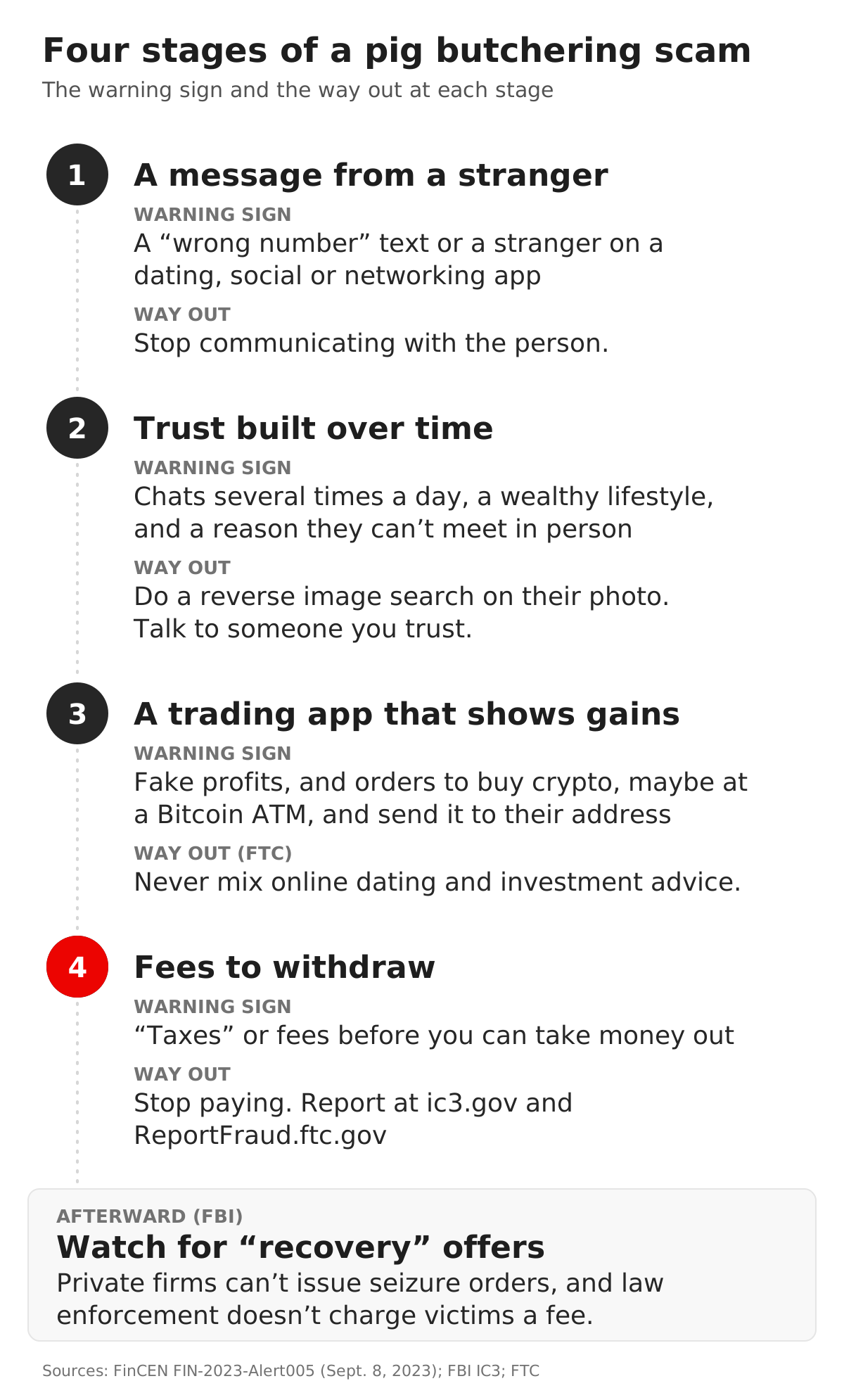
The FBI and the Treasury Department’s Financial Crimes Enforcement Network, or FinCEN, call this a pig butchering scam. FinCEN broke it into four stages in a Sept. 8, 2023, alert, and each stage has a warning sign you can spot and a way out.
Who is on the other end of the chat
FinCEN says the name comes from the practice of fattening a hog before slaughter. Scammers build trust with fake identities and long storylines, then take everything the person has put in.
Most of these operations are run by criminal groups based in Southeast Asia that use victims of human trafficking as forced labor, according to FinCEN and the FBI. A significant number of the people sending the messages are likely trafficking victims themselves, working against their will.
In a Sept. 3, 2026, release, FinCEN said financial institutions filed 33,904 reports of suspected scams like this from Sept. 8, 2023, through Dec. 31, 2025, tied to about $12.7 billion, with targets of all ages in all 50 states.
A wrong-number text is the first warning sign
The opening message usually comes as a text or a social media message that pretends to reach a wrong number or to reconnect with an old friend. Dating sites, professional networking sites and messaging apps are on FinCEN’s list too.

The FBI adds advertisements, and says scammers quickly move the conversation to a messaging platform.
If a stranger you never contacted keeps the chat going and asks you to switch apps, stop replying. Like the impersonation scams in The Scam Doesn’t Start at the Kiosk, this one starts long before anyone mentions money.
Check a new contact before you trust them
The scammer keeps in touch “over time to establish trust and build a relationship,” FinCEN says, and may pose as an investor or money manager whose social media profile shows off wealth.
Romance scammers sometimes chat several times a day and say they can’t meet you in person, according to the Federal Trade Commission. It suggests a reverse image search of the person’s profile picture and a talk with someone you trust.
The FTC’s rule for this stage is “Never send money or gifts to a sweetheart you haven’t met in person.”
How to tell the trading app is fake
Once trust is in place, the scammer brings up a crypto investment and sends you to a website or app built to look legitimate but controlled by the scammer. Sometimes it is a real app fitted with add-ons that let the scammer falsify what you see.

Then the balance climbs. Scammers show made-up returns, may let you withdraw a small amount to build confidence, and offer loans so you can invest larger sums.
How you are told to pay is a red flag too. One sign on FinCEN’s list is a new contact who tells you to put cash into a crypto kiosk and send the coins to an address they supply. If that request comes with a Bitcoin ATM, it fits the pattern, and Is Your Bitcoin ATM Safe? covers what to do if you’re already at the machine.
The platform can give itself away with poor spelling and grammar, a web address misspelled to look like a real company’s, a newly registered domain, no street address, contact only by chat or email, or an app you were told to install from a website instead of a well-known app store.
The FTC puts it plainly. “Never mix online dating and investment advice,” it says, and “Only scammers will guarantee profits or big returns.”
Don’t pay the fee to withdraw
The last stage starts when you slow down or ask for your money back. The scammer may claim losses you need to cover, or demand “taxes” or early withdrawal fees before anything is released.
The FBI calls the tax and fee demand a final attempt to take more before the scammers disappear with the victims’ money. Once a person can’t or won’t pay, the scammer cuts off contact and keeps the whole investment.
For the fee itself, the FTC’s rule is “Only scammers demand payment in cryptocurrency.” Stop paying, and save the chats, usernames, web addresses and payment records before the site or the account disappears.
How to report a pig butchering scam
Report it to the FBI at ic3.gov and to the FTC at ReportFraud.ftc.gov. The FTC also says to call your bank or the company you paid through right away, tell them you paid a scammer and ask for a refund, then notify the app or site where you met the person.
When you file, the FBI asks for how the person first contacted you, the names and usernames they used, and each payment’s date, amount and receiving crypto address.
If the money went through a Bitcoin ATM, contact the company that runs the machine too. Byte Federal operates Bitcoin ATMs. If you used one of its machines, contact Byte Federal support right away at (786) 686-2983 or email support@bytefederal.com.
Older victims can also call the Justice Department’s National Elder Fraud Hotline at 833-FRAUD-11 (833-372-8311), Monday through Friday from 10 a.m. to 6 p.m. ET.
Watch for the recovery scam that comes next
Expect offers to get the money back. The FBI warned on Aug. 11, 2023, that fake recovery firms find victims on social media and in search results, charge an up-front fee, then vanish or ask for more, sometimes claiming ties to law enforcement.
“Private sector recovery companies cannot issue seizure orders to recover cryptocurrency,” the FBI said, and law enforcement does not charge victims a fee to investigate.
The FBI may also reach you first. Its Operation Level Up contacted 3,780 crypto investment fraud victims in 2025, and 78% of them didn’t know they were being scammed. If someone says they are with the FBI, confirm it with your local FBI field office.
For fake job offers, giveaway schemes, SIM swaps and other crypto scams, see Avoiding Bitcoin Scams.
Some images in this article were generated with AI.
This article is for educational purposes only and is not financial advice.
Sources
- Financial Crimes Enforcement Network (FinCEN), FinCEN Alert on Prevalent Virtual Currency Investment Scam Commonly Known as “Pig Butchering” (FIN-2023-Alert005), Sept. 8, 2023.
- Financial Crimes Enforcement Network (FinCEN), FinCEN Identifies Nearly $13 Billion Linked to Suspected Digital Asset Scams Operated by Overseas Scam Centers, Sept. 3, 2026.
- FBI Internet Crime Complaint Center, 2025 IC3 Annual Report, 2026, accessed Nov. 5, 2026.
- FBI Internet Crime Complaint Center, Cryptocurrency Investment Schemes (I-100322-PSA), Oct. 3, 2022.
- FBI Internet Crime Complaint Center, Increase in Companies Falsely Claiming an Ability to Recover Funds Lost in Cryptocurrency Investment Scams (I-081123-PSA), Aug. 11, 2023.
- Federal Trade Commission, What To Know About Cryptocurrency and Scams, accessed Nov. 5, 2026.
- Federal Trade Commission, What To Know About Romance Scams, accessed Nov. 5, 2026.
- Office for Victims of Crime, National Elder Fraud Hotline, accessed Nov. 5, 2026.
Frequently asked questions
What is a pig butchering scam?
It is a long-running cryptocurrency investment fraud, also called a crypto romance scam. A stranger builds a friendship or romance, steers you to a fake trading website or app that shows invented gains, then demands taxes or fees before you can withdraw. FinCEN says the name comes from the practice of fattening a hog before slaughter.
Why can a "wrong number" text be the start of a scam?
FinCEN says pig butchering scams usually start with a text or social media message that pretends to reach a wrong number or reconnect with an old friend. Once the person replies, the scammer keeps in touch over time to build trust. The FBI says scammers quickly move the chat to a messaging platform.
Why do pig butchering scammers ask for taxes or fees before a withdrawal?
The FBI describes the tax and fee demand as a last attempt to take more money before the scammers disappear. The balance on the app was never real. The FTC says "Only scammers demand payment in cryptocurrency," so stop paying and report it at ic3.gov and ReportFraud.ftc.gov.
Can a crypto recovery company get my money back?
Be wary. The FBI warns that fake recovery firms charge up-front fees and sometimes claim ties to law enforcement. "Private sector recovery companies cannot issue seizure orders to recover cryptocurrency," the FBI said, and law enforcement does not charge victims a fee to investigate.
Who is behind pig butchering scams?
FinCEN and the FBI say most operations are run by criminal organizations based in Southeast Asia that use victims of human trafficking as forced labor. FinCEN says a significant number of the people sending the messages are likely trafficking victims themselves, acting against their will.
Topics in this guide
- scams
- fraud-prevention
- security
- safety