

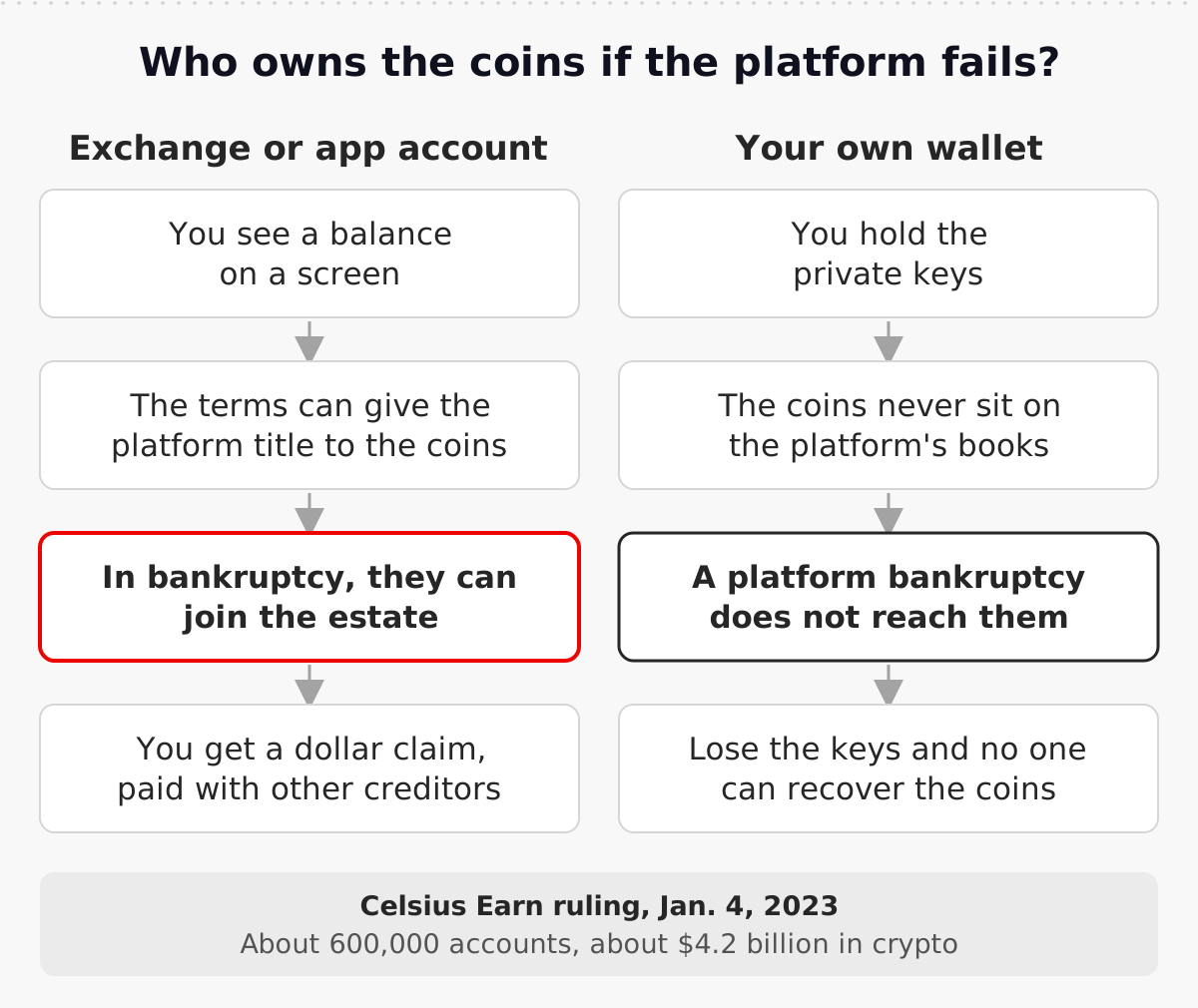
The terms of use for Celsius Network’s Earn accounts handed the company title to about $4.2 billion in customers’ crypto, and on Jan. 4, 2023, a federal bankruptcy judge enforced them.
That figure was the market value of roughly 600,000 Earn accounts as of July 10, 2022. The ruling covered Earn only and did not decide who owned coins in Celsius’s custody accounts.
The case shows what happens to crypto if an exchange goes bankrupt after its terms give it title to your coins. They can become part of its bankruptcy estate, the pool of assets a court divides among everyone the company owes.
You are left with a claim, not coins. FTX and Celsius valued claims in dollars at prices from the day each filed, and each took more than a year to start paying.
Celsius was a crypto lender rather than a trading exchange. Any exchange or app that holds coins for you also asks you to accept its terms, and terms are what the judge read.
The contract decides who owns your coins
Chief U.S. Bankruptcy Judge Martin Glenn of the Southern District of New York put it in one line of his opinion in case No. 22-10964: “The issue of ownership of the assets in the Earn Accounts is a contract law issue.”
The contract was Celsius’s terms of use. The controlling version gave Celsius “all right and title to such Eligible Digital Assets, including ownership rights.”
Customers had clicked to accept it. Celsius showed that 99.86% of Earn account holders agreed to Terms Version 6 or a later one, and Glenn found the title language unambiguous.
That made Earn customers unsecured creditors, who can claim a share of what is left but not any particular coin. Glenn wrote that “There simply will not be enough value available to repay all Account Holders in full.”
On March 21, 2023, Glenn approved a separate settlement for Celsius’s Custody Program. Custody holders who opted in could recover 72.5% of their crypto.
FDIC insurance won’t cover an exchange failure
FDIC insurance pays only when an FDIC-insured bank fails. In a fact sheet issued July 29, 2022, the agency said “deposit insurance does not apply upon the failure of a non-bank, such as a crypto company,” and listed crypto assets among the products it does not protect.
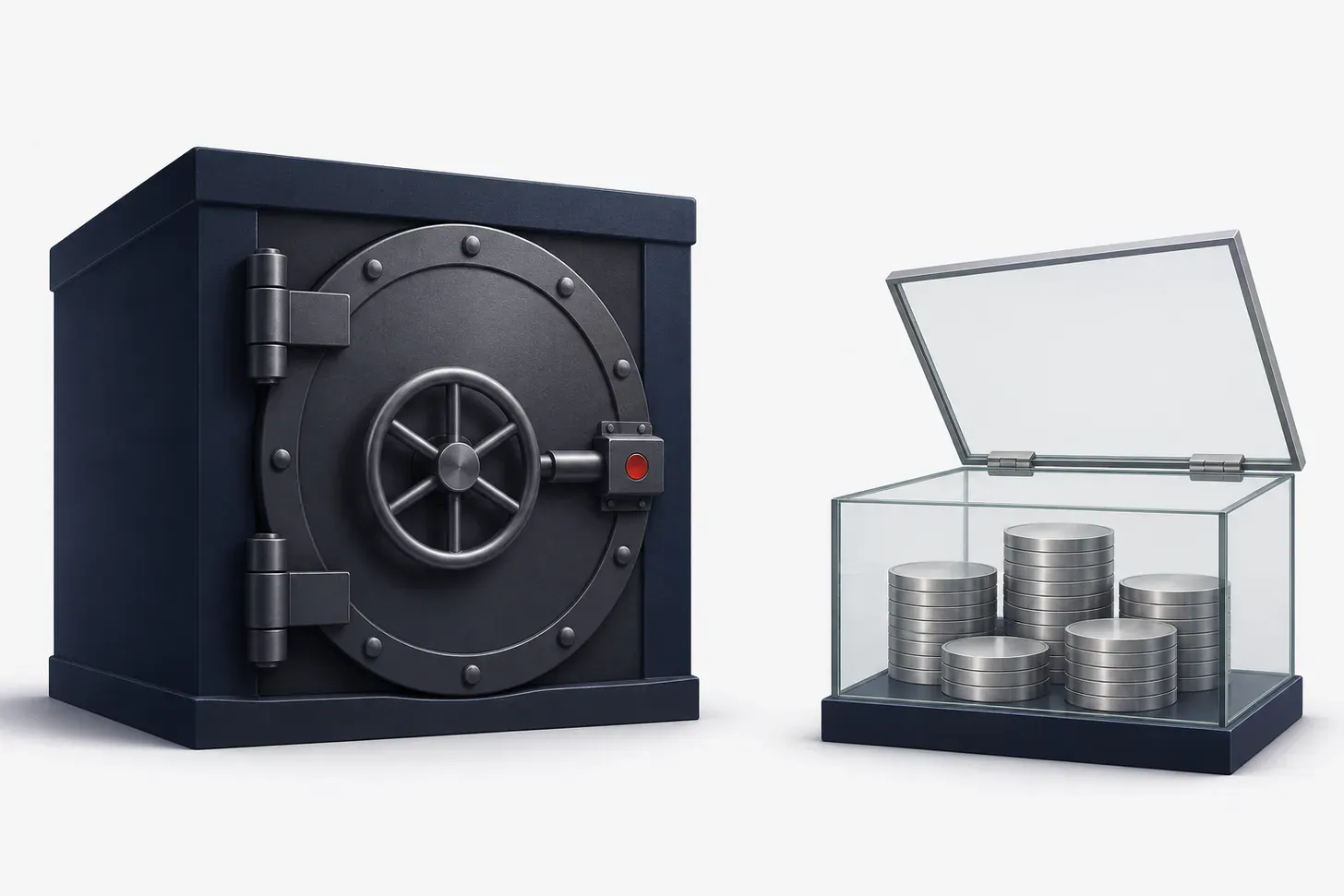
Brokerage protection does not fill the gap. The Securities Investor Protection Corp. says it “does not protect any digital or crypto asset that does not qualify as a ‘security.’”
The Federal Trade Commission tells consumers that if an online exchange platform goes out of business, “you’re likely to find that no one can step in to help you recover your funds.”
What happens to your crypto claim when an exchange goes bankrupt
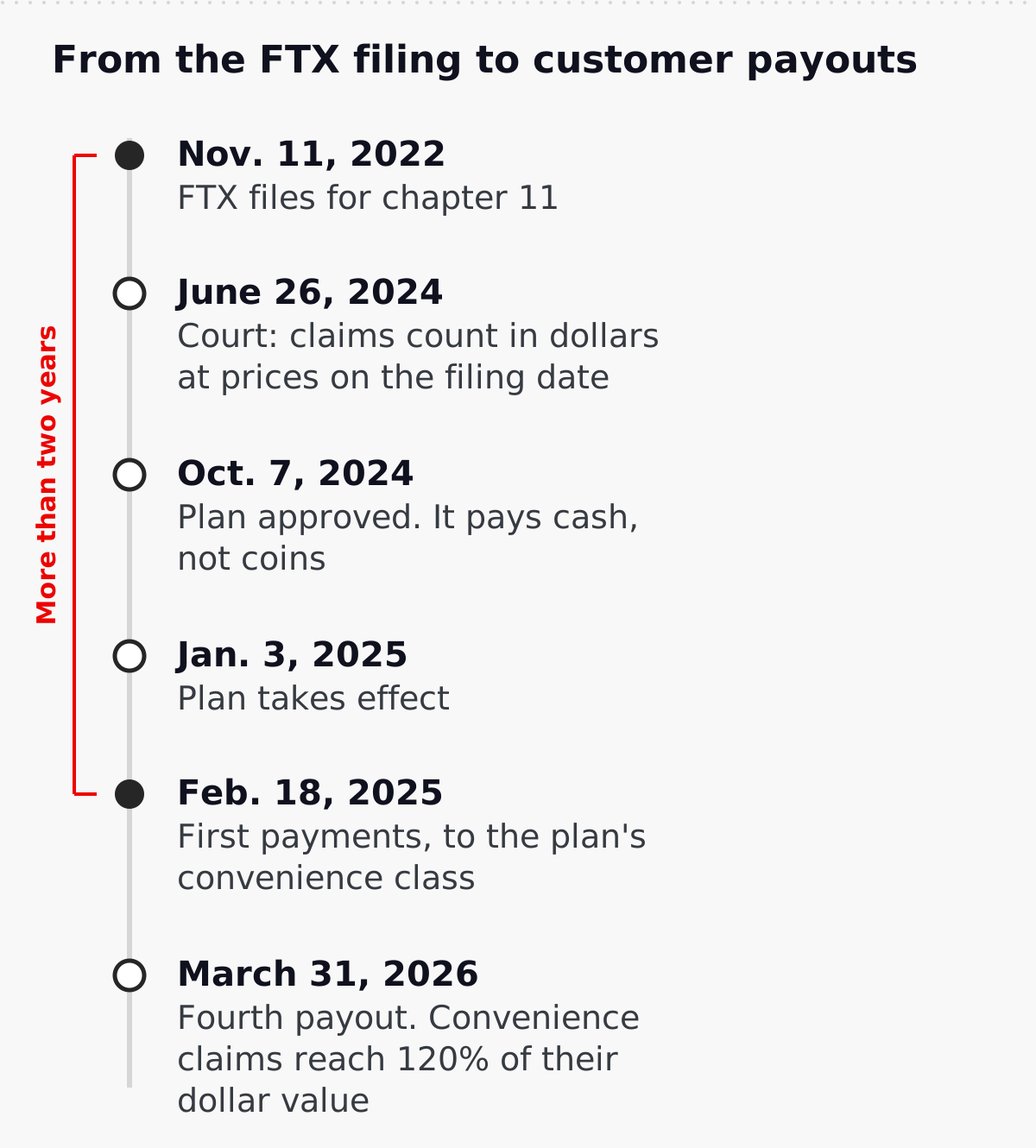
FTX, which filed for chapter 11 on Nov. 11, 2022, shows how the coins in your account turn into a dollar figure. It received millions of claims stated in coins.
On June 26, 2024, U.S. Bankruptcy Judge John T. Dorsey in Delaware wrote that “the value of the claims must be determined as of the petition date as if the bankruptcy had never occurred.” FTX converted each coin to U.S. dollars with a conversion table.
A customer who held bitcoin on FTX therefore had a claim fixed at November 2022 prices, whatever bitcoin did afterward.
Dorsey approved the FTX plan on Oct. 7, 2024. It paid in cash, and an adviser to the FTX debtors said they did “not have cryptocurrency” to return in kind, The Block reported.
The first payments went to the plan’s convenience class on Feb. 18, 2025, more than two years after the filing. Only customers who had passed identity checks and filed tax forms were paid.
By the fourth payout, which began March 31, 2026, the FTX Recovery Trust said convenience claims had received 120% of their dollar value, U.S. customer claims 100% and FTX.com customer claims 96%.
Celsius valued claims the same way. Its claims agent says each claim “was calculated in US dollars based on the assets showing in your Celsius account on the bankruptcy filing date,” July 13, 2022.
Celsius began paying creditors in bitcoin, ether and dollars on Feb. 1, 2024. By Aug. 27, 2024, it had sent more than $2.53 billion to about 251,000 of 372,000 eligible creditors, according to The Block.
The House-passed fix is not law
The House passed the Digital Asset Market Clarity Act, H.R. 3633, on July 17, 2025. Its text says assets a digital commodity exchange holds for a customer “shall be considered customer property” under section 761 of the Bankruptcy Code.
The bill would also make it unlawful for such an exchange to use customer property as its own. The Senate failed to advance it in a procedural vote on Sept. 15, 2026, and as of Nov. 5, 2026, it had not become law.
How to check your own exposure
- Read the custody or ownership section of your platform’s terms. Wording like the Celsius grant of “all right and title” is what the court read as handing ownership to the platform.
- Know which program holds your coins. At Celsius, the Earn ruling covered Earn accounts only, and custody holders later settled for 72.5%.
- Treat any claim that crypto is FDIC-insured as a warning sign. The FDIC said such statements from crypto companies are “inaccurate.”
- Save statements and screenshots of your balances. FTX and Celsius both set claims from what accounts held on the filing date.
- Consider moving coins you are not trading to a wallet where you hold the private keys, the secret codes that authorize spending. ByteU’s Bitcoin wallets guide explains how.
Self-custody moves the risk to you. The FTC lists losing the password to your digital wallet among the cases where no one can step in to help.
ByteU’s guides to self-custody vs custodial solutions and to Bitcoin custody solutions cover how people manage that trade-off.
The Celsius terms that decided the Earn case took effect April 15, 2022. The company filed for bankruptcy on July 13, 2022, three months later.
Some images in this article were generated with AI.
This article is for educational purposes only and is not financial advice. It is not legal advice either.
Sources
- U.S. Bankruptcy Court for the Southern District of New York, “Memorandum Opinion and Order Regarding Ownership of Earn Account Assets,” In re Celsius Network LLC, Case No. 22-10964 (MG), Jan. 4, 2023.
- The Block, “Judge approves Celsius custody account settlement to return 72.5% of crypto assets,” March 21, 2023.
- FDIC, “FDIC Issues a Fact Sheet to the Public on FDIC Deposit Insurance and Crypto Companies,” July 29, 2022.
- FDIC, “Understanding Deposit Insurance,” updated April 1, 2024, accessed Nov. 5, 2026.
- SIPC, “What SIPC Protects,” accessed Nov. 5, 2026.
- Federal Trade Commission, “What To Know About Cryptocurrency and Scams,” May 2022.
- U.S. Bankruptcy Court for the District of Delaware, “Memorandum Opinion and Order” on estimation of digital asset claims, In re FTX Trading Ltd., Case No. 22-11068 (JTD), June 26, 2024.
- The Block, “US bankruptcy judge approves FTX reorganization plan, two years after the exchange’s collapse,” Oct. 7, 2024.
- FTX via PR Newswire, “FTX Announces Initial Distribution Date of February 18, 2025 for Convenience Class Creditors,” Feb. 7, 2025.
- FTX Recovery Trust via PR Newswire, “FTX Recovery Trust to Distribute Approximately $2.2 Billion to Creditors in Fourth Distribution on March 31, 2026,” March 18, 2026.
- Stretto, Celsius claims agent, “Distribution Calculation, Partners, Reporting, and Other Questions,” accessed Nov. 5, 2026.
- The Block, “Celsius bankruptcy distributions exceed $2.5 billion to 251,000 creditors,” Aug. 27, 2024.
- U.S. House of Representatives, “H.R. 3633, Digital Asset Market Clarity Act of 2025, engrossed in House,” passed July 17, 2025.
- CNBC, “Senate cloture vote on Clarity Act fails, dealing regulatory blow to crypto industry,” Sept. 15, 2026.
Frequently asked questions
Is crypto on an exchange FDIC insured?
No. The FDIC said in July 2022 that deposit insurance does not apply when a non-bank, such as a crypto company, fails, and it lists crypto assets among the products it does not insure. Its coverage protects deposits at insured banks, up to $250,000 per depositor, per bank, for each ownership category.
Do I own the crypto in my exchange account?
It depends on the platform's terms of use. In January 2023 a bankruptcy judge ruled that Celsius owned the crypto in its Earn accounts because its terms gave Celsius all right and title to deposits. The same ruling left Celsius custody accounts undecided, and those holders later settled for 72.5%.
Will I get my bitcoin back if an exchange goes bankrupt?
Often you get dollars instead. FTX claims were valued in U.S. dollars at prices on its Nov. 11, 2022 filing date, and its plan paid cash. Celsius valued claims in dollars as of its July 13, 2022 filing date, then paid creditors in bitcoin, ether and dollars.
How long does it take to get money back from a bankrupt exchange?
In the FTX and Celsius cases it took well over a year. FTX filed on Nov. 11, 2022, and made its first payments on Feb. 18, 2025. Celsius filed on July 13, 2022, and began paying creditors on Feb. 1, 2024.
Does a self-custody wallet protect me if an exchange fails?
Coins in a wallet where only you hold the private keys are not held by the exchange, so its bankruptcy does not reach them. The trade-off is that the FTC says no one can step in to help if you lose the password to your wallet.
Topics in this guide
- custody
- self-custody
- exchanges
- security
- consumer-protection