
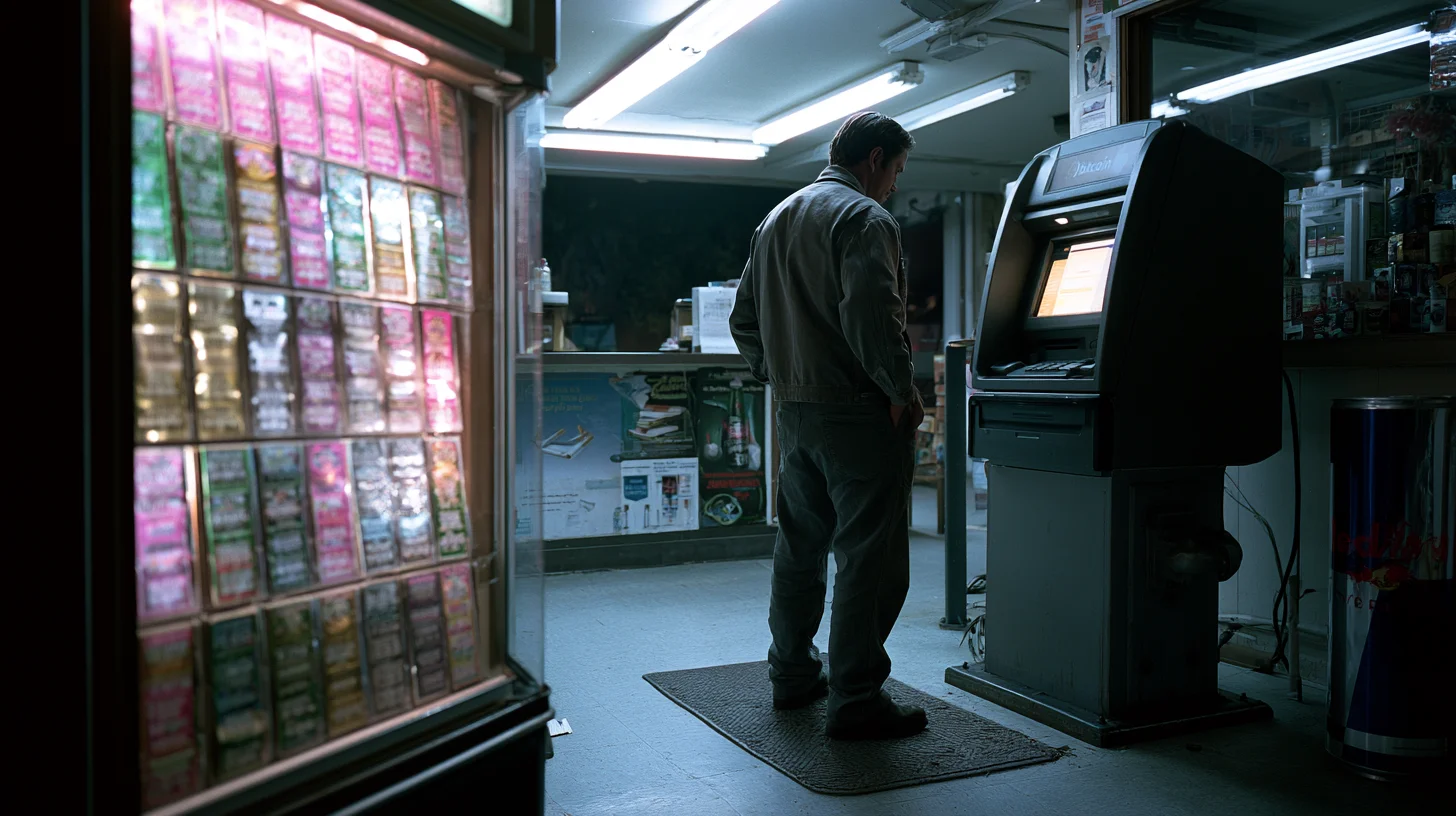
There is a counter at the Marathon station on Veterans Memorial Boulevard in Metairie, Louisiana, and behind it is a rack of scratch-off tickets arranged by price: two dollars, five, ten, twenty. Next to the register stands a Bitcoin ATM, just three feet away. They face the same customers, accept the same crumpled bills, and do fundamentally opposite things with the money.
What follows is told in transaction records — 21,691 people, 130,046 purchases1 — and the numbers sit uncomfortably alongside the claims state lotteries make about funding education.
The Counter
Americans spent $104.7 billion on lottery tickets in 2024.2 One hundred and four billion dollars — more than the combined revenue of Netflix, Spotify, and every movie studio in Hollywood — fed into machines and across counters at gas stations, bodegas, dollar stores, and supermarkets in forty-five states.
Most of that money flows in one direction. On average, lotteries pay out fifty cents on every dollar wagered,3 meaning that for every hundred billion spent, fifty billion vanishes into state coffers, retailer commissions, and administrative overhead. What returns to players arrives unevenly, since jackpot winners — the ones on the poster, holding the oversized checks — absorb a disproportionate share. Most players walk into a gas station with a twenty and walk out with a piece of paper worth zero.
In Massachusetts, residents spend $856 per capita on lottery tickets annually. Among the lowest-income weekly players — those earning under $30,000 — spending runs approximately $412 per year, and the expected return is roughly $206.45 That gap is a tax, and according to the Federal Reserve Bank of Boston, it is the most regressive form of public finance in the country — more regressive than sales taxes or excise taxes on alcohol and tobacco.6 A 2024 study in the Review of Economic Studies found that Americans would spend 43 percent less on lotteries if they understood the true probabilities.7 Statistical confusion, in other words, is doing the selling — and the people paying the highest effective rate are those with the least money and the least access to financial education.
Three feet away, at the Bitcoin ATM, something different is happening.
The Stackers
Buried inside the transaction database of one of America's largest Bitcoin ATM operators is a population of customers that defies every stereotype about cryptocurrency. They are gas station regulars — people who walk in with twenty, forty, sixty dollars in cash and buy small amounts of Bitcoin the way their neighbors buy Powerball tickets.
They do it again the next week, and the week after that, with a consistency that looks less like gambling and more like habit.
Among the 21,691 individuals in the data who made at least one Bitcoin purchase of $100 or less at a physical ATM kiosk, a cohort emerges: 1,438 customers who returned twenty or more times. Within that group, 819 kept coming back for over a year, buying in small amounts and sending it to the same wallet or a small handful of wallets.
In the Bitcoin community they call it "stacking sats" — sats being the smallest unit of the currency, one hundred-millionth of a coin, named for Satoshi Nakamoto. At the gas station, the practice probably goes unnamed; people just show up with cash.
Here is what happened to their money.
Over an average of two years, each of the 819 long-term stackers invested $3,931, typically $56 at a time — less than the cost of a modestly ambitious Friday night. Collectively they put in $3.2 million, a sum too modest to fund a single thirty-second Super Bowl commercial, and that $3.2 million bought 102.37 Bitcoin.
At current prices, those coins are worth $10.95 million. On average, each stacker turned $3,931 into $13,374 — a result that reflects the deflationary mechanics of an asset with a fixed supply of 21 million coins in a world where the supply of dollars keeps expanding.8 Two out of every five have tripled their money or more, and only 7.6 percent are underwater.
Widen the lens to the full population. All 21,691 people who ever bought Bitcoin for under $100 at one of these ATMs collectively invested $7.5 million and accumulated 304.45 coins, currently worth $32.6 million.
Had they spent that $7.5 million on lottery tickets instead, the expected return would be approximately $3.8 million, and most would have received zero.
It amounts to a 430 percent return on one side and a net loss of 50 percent on the other. At the scale of $7.5 million, the gap is $28.8 million — twenty-eight million dollars sitting in the wallets of gas station customers because they chose the machine on the right.
The Stories the Data Tells
Transaction records guard names, faces, and motivations, but they reveal patterns instead — and the patterns are extraordinary.
Stacker Number One, from a zip code in southwest Florida where the median household income is around $71,000, made 148 purchases over 1.3 years, putting in roughly $37 each time — about the cost of a tank of gas in a Honda Civic. His total cash invested came to $5,436, accumulating 3.4995 coins of Bitcoin. Its current value: $374,000. That is a 6,788 percent return — eighty dollars a week, the price of a Saturday night scratch-off habit, building a nest egg larger than the median American household's net liquid wealth.
Stacker Number Six, also from southwest Florida, spent considerably less: 185 visits at $18 each. Eighteen dollars — less than a Mega Millions ticket with the Megaplier. Over one year, $3,296 flowed into a single wallet at a pace that suggests a lunch break ritual or a Friday evening stop on the way home, and today that wallet holds $90,608.
Stacker Number Twelve, from the Birmingham, Alabama metro area — where the median household income is $62,000 — may be the most striking of all. He made eighty-two transactions spanning 7.1 years, averaging about $14 a week with the cadence of a subscription and the price of a few lottery tickets. His total investment of $4,985 accumulated so slowly it probably felt like routine rather than strategy, yet its current value stands at $73,263.
He followed the same rhythm as a scratch-off habit — same counter, same small bill peeled off a paycheck — but instead of a piece of paper with a one-in-three-hundred-million chance of being worth something, he accumulated a fraction of a mathematically scarce digital asset. Sat by sat, the wallet grew.
Wall Street has a name for what he did: dollar-cost averaging, the most disciplined strategy in the professional money manager's playbook. It was executed with twenty-dollar bills at a gas station, without a brokerage account or a financial adviser.
The Geography
Where these stackers live complicates every assumption about who buys cryptocurrency.
Florida leads with 181 long-term small-amount stackers, followed by Georgia with 115 and Alabama with 92. Then come North Carolina, Tennessee, South Carolina, Mississippi, Kentucky, Missouri, and Michigan — all through the American South, the states with the highest rates of unbanked households, the heaviest lottery participation, the most dollar stores per capita, and the deepest historical exclusion from institutional finance.
These zip codes produce lottery revenue, but they do not produce venture capitalists.
According to the FDIC's 2023 National Survey, 10.6 percent of Black households and 9.5 percent of Hispanic households are completely unbanked.9 Black households represent 12.9 percent of all American households but 32.3 percent of unbanked ones, and two-thirds of those households rely entirely on cash.
For this population, a Bitcoin ATM at a gas station is infrastructure — it is the only device in the building that converts earned cash into a digital asset the buyer controls. It is open to anyone with a phone and an ID, independent of bank approval, credit history, or minimum balances, and priced below the fees that check-cashers and payday lenders extract.
Isaiah Jackson, in his 2019 book Bitcoin and Black America, described a community systematically excluded from wealth-building for generations.10 He documented the toll of redlining, predatory lending, and a financial crisis in which borrowers in Black neighborhoods were twice as likely to be refinanced into subprime loans. His argument was spare: a permissionless financial system — one that operates independently of institutional approval — offers something that bank reform and government programs have never delivered. An exit.
"Redlining and predatory lending only happened because you need permission in the fiat system," Jackson has said. "Bitcoin is permissionless."10
A Coinbase survey found that one in three Black investors owns cryptocurrency, compared to 17 percent of white investors.11 Research from the Federal Reserve Bank of Kansas City shows that crypto adoption in Black communities is driven by structural factors — distrust of traditional institutions, desire for financial autonomy, and the appeal of a system that treats every participant identically regardless of credit history or skin color.12
In 2022, Jay-Z and Jack Dorsey funded The Bitcoin Academy at the Marcy Houses public housing project in Brooklyn — the complex where Jay-Z grew up — offering free twelve-week courses on Bitcoin, personal finance, and blockchain technology.13 They provided participants with smartphones and data plans. From the mission statement: "The vision for Bitcoin is that it doesn't have barriers, but lack of access to financial education is a barrier."
A stacker in Alabama, putting $40 of cash into a Bitcoin ATM every Friday, is part of this movement whether they know it or not. They are participating in a parallel financial system — one that is open at midnight on Christmas, that treats a janitor's $20 with the same protocol as a hedge fund's $20 million, and that will still be there if every bank in the state closes its doors.
The Machine and the Ticket
Stand at any gas station counter that has both a lottery terminal and a Bitcoin ATM, and watch the customers. Demographically, the overlap is nearly total — same cash, same small bills, same weekly rhythm. Only the direction differs.
One choice feeds a system engineered to return fifty cents on every dollar — so profitable that forty-five states operate their own version, spending billions on advertising to convince their poorest residents that this week might be different. Georgia's lottery funds a college scholarship program that disproportionately benefits higher-income families — the ones who were going to college anyway — paid for by tickets purchased disproportionately by lower-income households who were not.14 By construction, it moves money from people who have too little of it to people who have enough.
The other choice feeds a protocol — a set of mathematical rules that caps Bitcoin's supply at 21 million coins, enforces that cap through distributed consensus, and allows anyone with an internet connection to hold, send, and receive value. At the gas station, the machine is simply the physical interface — the point where cash crosses into that protocol.
For the median lottery player, every dollar wagered has an expected value of fifty cents and a most-likely value of zero. For the stackers in this dataset, every dollar returned 430 percent on average, with 92.4 percent of long-term participants in the black.
Bitcoin is volatile, and past performance guarantees nothing. It has crashed fifty percent or more on multiple occasions; the stackers who started in 2021 watched their holdings fall by two-thirds before recovering, and some of the 7.6 percent currently underwater bought at prices near the all-time high.
Yet in its entire history, the lottery has never produced a positive expected return, while Bitcoin has produced a positive actual return for 92 percent of the people in this data who committed to buying small amounts over a year or longer. Volatility is the price of admission to a system whose long-term trajectory has been up; certainty is the feature of a system whose long-term trajectory is down.
The Ban
On January 28, 2026, Indiana House Bill 1116 passed the state House of Representatives 87 to 7.15 It established a comprehensive regulatory framework for cryptocurrency ATMs: operator licensing, identity verification, transaction limits, fraud training, law enforcement cooperation — thoughtful guardrails around a new technology.
What Governor Mike Braun signed on March 9 bore no resemblance to that bill. The Senate committee had stripped the entire framework and replaced it with a single sentence: "A person may not operate a virtual currency kiosk in Indiana."16
Nine hundred and three machines went dark overnight, as operators faced immediate forfeiture of hardware and all transaction revenue. Gas station owners who allowed a machine to remain on their premises faced identical liability. Tennessee went further: its ban made it illegal to even place a Bitcoin ATM on a premises — powered on or off, operational or inert — so that possessing the machine itself became a violation.
Fraud was the stated reason — elder fraud specifically, in which scammers convince victims to deposit money at a Bitcoin ATM. That fraud is real and genuinely harmful, but the surrounding numbers deserve scrutiny.
FBI data from 2024 places Bitcoin ATM fraud at $246.7 million in annual losses.17 In the same report: bank wire transfer fraud totaled $2.09 billion; check fraud, $26.6 billion; gift card fraud, $212 million. TRM Labs, the blockchain intelligence firm, estimates that 98.8 percent of all Bitcoin ATM transactions are entirely legitimate.18 Indiana banned the payment method with the lowest fraud rate of any available at the same gas stations.
That same year, the Indiana Hoosier Lottery sold $1.6 billion in tickets, and the state kept more than $300 million while the lottery terminals stayed right where they were.
Among the people who used those 903 machines were stackers — walking in with $20 and $50, buying fractions of a coin, sending them to the same wallet week after week. They were people who turned $5,000 into $73,000 over the better part of a decade, people doing exactly what the financial advice industry tells everyone to do: invest small amounts consistently over a long period of time.
Those 903 machines were removed, yet the gas stations where they stood continue to sell lottery tickets.
The Sovereign Counter
A Bitcoin ATM does something unique in American finance: it converts cash into an asset that the buyer, and only the buyer, controls.
Consider what the alternatives actually offer. A lottery ticket is a claim against the state, a bank deposit is a claim against the bank, and Bitcoin held on Coinbase is a claim against the exchange — one that requires a bank account in the first place to fund.
Buy Bitcoin at a gas station ATM with cash and send it to your own wallet: you own Bitcoin — the actual thing, a private key living on your device, replicated across a global network that runs on mathematics rather than trust. It survives data breaches, bank failures, and the whims of any institution, and it will still be there when the bank that rejected your account application has merged, been acquired, or closed.
For the 5.6 million unbanked households in America — families who carry cash because the banking system has rejected them or priced them out — this is the difference between participating in the digital economy and being shut out of it. A Bitcoin ATM may be the only device in the American financial system that allows an unbanked person to convert cash directly into a digital asset without an account, a credit check, or an intermediary.
When Indiana closed that door, the scammers kept calling. FBI data shows that when one payment channel is eliminated, fraud migrates to the next available option.17 The calls continue, the social engineering continues, and victims get redirected to wire transfers and gift cards — payment methods with zero real-time fraud intervention and, in the case of gift cards, zero identity verification.
What stopped was the $20 weekly Bitcoin purchase — the quiet accumulation, the one financial tool at the gas station counter where the money was going in instead of coming out.
The Other Side of the Counter
Fifty million Americans buy at least one lottery ticket a year.19 Another hundred million join them when jackpots swell. Overwhelmingly, they are people of modest means engaging in what behavioral economists call "rational irrationality" — paying a small price for the psychological experience of hope, even when the mathematical expectation is negative.
The stackers in this data suggest a variation on that impulse — people of similar means making a similar weekly purchase, but one with a positive historical return. Discipline was the strategy, regularity was the edge, and a fixed supply of 21 million coins combined with fifteen years of growing demand did the rest.
Somewhere in America, right now, a person is standing at a gas station counter with a twenty-dollar bill, deciding which direction to turn. In twenty states, legislators are deciding for them.
The Spreading Ban
Indiana was first, and Tennessee followed in May 2026, signing a law that makes it a Class A misdemeanor to "permit, place, or otherwise operate a virtual currency kiosk in this state" — punishable by up to one year in prison and a $2,500 fine.20 Minnesota's Senate has passed a similar measure awaiting a House vote, while Vermont extended a moratorium on new machines through July 2026. Pennsylvania's Virtual Currency Kiosk Regulation Act received a committee hearing in April 2026.21
City councils have moved faster — Spokane, Washington; St. Paul and Stillwater, Minnesota; Layton, Utah have all banned crypto ATMs within their limits. Thirty states introduced bills related to crypto kiosks in 2026 alone, bringing the total that have passed laws to twenty.22
Some chose regulation over prohibition. Wyoming built a licensing framework. Wisconsin and Virginia set daily transaction limits. Even imperfect guardrails represent a more serious engagement with the problem than a one-sentence ban.
The measures that actually work are straightforward: mandatory hold times on large or first-time transactions, giving compliance teams a window to intervene before funds move, and enhanced due diligence requirements for customers over 60 — the demographic most targeted by scammers. Byte Federal already conducts live validation calls with every flagged senior customer, stopping 84 percent of attempted scams before the transaction completes. When legislation codifies what responsible operators already practice, it strengthens the industry. When it bans the machine outright, it eliminates the operators who invested in compliance alongside those who didn't.
Still, the numbers invite an uncomfortable question. Wire transfer fraud costs Americans $2.09 billion a year, gift card fraud costs $212 million, and check fraud costs $26.6 billion — yet none of these payment methods face state-level bans. State lotteries — which return fifty cents on every dollar and disproportionately draw from low-income households — operate with state sponsorship and billions in advertising budgets. Meanwhile, the one machine at the gas station counter that has demonstrably built wealth for working Americans, in amounts as small as $14 a week, is the one being unplugged. Data on elder fraud education campaigns — which raised gift card scam recognition from near zero to 82 percent in under a decade — suggests a proven, less destructive alternative exists, yet legislators have chosen prohibition over education. The question is why.
Each ban emboldens the next state's committee, and each ban removes machines from the counters where 21,691 people built $32.6 million in wealth, twenty dollars at a time.
Notes & Sources
- The figure of 21,691 individuals represents a snapshot of customer transaction data from Byte Federal's Bitcoin ATM network, filtered to completed buy transactions of $100 or less. The data is drawn from Byte Federal's internal transaction records spanning 2018 through 2026, representing typical customer behavior patterns at Bitcoin ATMs located in gas stations, convenience stores, and retail locations across 42 U.S. states. No customer selection or filtering beyond the transaction amount threshold was applied.
- U.S. Census Bureau, via The Motley Fool, "Lottery Statistics and Revenue by State," 2024. Americans spent $104.7 billion on lottery tickets in 2024; Massachusetts per capita: $856. fool.com/money/research/lottery-statistics
- The average lottery payout rate varies by state, ranging from approximately 17% to 79% of ticket sales returned as prizes, with a national average near 50%. The remaining revenue is split between state general funds, education earmarks, retailer commissions, and administrative costs. Source: Tax Policy Center, "State and Local Lottery Revenue"; U.S. Census Bureau, Annual Survey of State and Local Government Finances. taxpolicycenter.org
- Bankrate consumer survey, 2024. Sub-$30K weekly players spend ~$412/year; $75K+ households ~$105/year. Cited in SearchLogistics analysis of lottery spending by income bracket.
- For context: the $412 spent annually by a low-income weekly lottery player, if instead invested in Bitcoin at the 430% blended return observed across the dataset in this article, would be worth approximately $5,315 after three years or $8,858 after five years. The $856 per-capita Massachusetts figure would yield approximately $11,042 (three years) or $18,404 (five years). These figures apply the dataset's blended return and are illustrative, not predictive. Bitcoin has experienced drawdowns exceeding 50% and past returns are not indicative of future performance.
- Federal Reserve Bank of Boston, "New England's Lotteries: Trends in State Revenues and Player Spending," 2024. bostonfed.org
- Lockwood, Allcott, Taubinsky & Sial, "Regressive Sin Taxes, with an Application to the Taxation of Lottery," Review of Economic Studies, 2024. PDF
- Bitcoin's supply is capped at 21 million coins by its protocol, with new issuance halving approximately every four years. This fixed supply contrasts with the U.S. dollar, whose M2 money supply has grown from $4.6 trillion in 2000 to over $21 trillion in 2024 — a 350% increase that erodes the purchasing power of every dollar in circulation. Bitcoin is volatile within its four-year halving cycles, with drawdowns of 50–80% occurring regularly. However, over every rolling four-year period in its history, Bitcoin has appreciated in dollar terms. This pattern is related to a broader economic divergence: beginning in the early 1970s, after the U.S. severed the dollar's link to gold, worker productivity and worker compensation — which had risen in lockstep for decades — began to separate. Productivity continued climbing; real wages flattened. The gains from technological progress increasingly accrued to capital owners rather than wage earners. Bitcoin's fixed-supply design means that holders — including gas station stackers buying $20 at a time — participate in an asset whose scarcity captures some of those productivity gains that the inflationary dollar no longer passes through to wages. This is not a guarantee of future appreciation, but it is the structural reason that a mathematically scarce asset has historically outpaced inflation over multi-year periods.
- FDIC, "2023 National Survey of Unbanked and Underbanked Households," November 2024. Black unbanked rate: 10.6%, Hispanic: 9.5%, White: 1.9%. 5.6 million households entirely unbanked. fdic.gov/household-survey
- Isaiah Jackson, Bitcoin and Black America (2019). See also CoinFlip interview, "How Bitcoin Can Benefit Black Communities with Isaiah Jackson." coinflip.tech
- Coinbase, "Black Americans & Crypto" research report. One in three Black investors owns cryptocurrency vs. 17% of white investors. coinbase.com
- Federal Reserve Bank of Kansas City, "The Cryptic Nature of Black Consumer Cryptocurrency Ownership," Payments System Research Briefing. kansascityfed.org
- Jay-Z and Jack Dorsey, The Bitcoin Academy at Marcy Houses, Brooklyn, NY. Launched June 2022 with personal grants. Rolling Stone, "Jay-Z, Jack Dorsey Launch 'Bitcoin Academy' Program in Marcy Projects." rollingstone.com
- Governing Magazine, "Lotteries Are a Regressive Tax. Why Do Progressive Governors Support Them?" Georgia's HOPE scholarship program funded by lottery proceeds disproportionately benefits higher-income families. governing.com
- LegiScan, Indiana HB 1116, 2026 session. House passed 87-7 on January 28, 2026. Senate committee substituted full text. legiscan.com
- Official text: Indiana General Assembly, HEA 1116, Section 8: "A person may not operate a virtual currency kiosk in Indiana." Signed March 9, 2026, with emergency clause. iga.in.gov
- FBI, Internet Crime Complaint Center (IC3), 2024 Internet Crime Report. Bitcoin ATM fraud: $246.7M. Wire transfer fraud: $2.09B. Check fraud: $26.6B. Gift card fraud: $212M.
- TRM Labs, blockchain intelligence analysis, 2024. 98.8% of Bitcoin ATM transactions are legitimate. See also Byte Federal's compiled research at bytefederal.com/fraud-prevention.
- Gallup polling; approximately 50% of American adults buy at least one lottery ticket per year, approximately 160 million people.
- The Record from Recorded Future News, "Tennessee becomes second state to ban cryptocurrency ATMs over scam concerns," May 2026. Class A misdemeanor; up to 1 year prison, $2,500 fine. therecord.media
- ABA Banking Journal, "States tighten reins on 'crypto ATMs,'" April 2026. Overview of Wyoming, South Dakota, Wisconsin, Virginia, Vermont, Minnesota, and Pennsylvania legislation. bankingjournal.aba.com
- AARP, "How States Are Taking Aim at Combating Crypto ATM Fraud," 2026. Thirty states introduced bills; twenty have passed laws as of 2026. aarp.org
Data Methodology. The transaction data cited in this article is drawn from anonymized, aggregated records of a major U.S. Bitcoin ATM operator. No personally identifiable information was accessed, used, or disclosed. Individual "stacker" profiles are derived from transaction patterns and do not represent identifiable persons. Bitcoin values are calculated at approximately $107,000 per BTC as of the date of publication.
Financial Disclaimer. This article is for informational and educational purposes only. It does not constitute financial advice, investment advice, trading advice, or any other kind of advice, and should not be treated as such. Cryptocurrency, including Bitcoin, is an extremely volatile and speculative asset. Its price can and does fluctuate dramatically, including the possibility of losing all or substantially all of its value. Past performance, including the returns described in this article, is not indicative of future results. The historical returns cited reflect a specific time period and a specific population of buyers; different time periods, entry points, and holding periods would produce materially different outcomes, including significant losses. Bitcoin has experienced drawdowns exceeding 50% on multiple occasions. You should not invest money you cannot afford to lose. Consult a qualified, licensed financial adviser before making any investment decisions. Byte Federal does not provide investment advice and makes no representation regarding the suitability of any investment.
Survivorship and Selection Bias. The data presented reflects customers who purchased and held Bitcoin. It does not account for customers who sold at a loss, abandoned wallets, lost access to private keys, or otherwise exited their positions before the measurement date. Actual outcomes across all Bitcoin ATM users may differ materially from the results presented.
Frequently asked questions
How much have small-amount Bitcoin ATM buyers made?
21,691 people who bought Bitcoin at ATMs for under $100 per transaction collectively invested $7.5 million and accumulated 304.45 BTC, currently worth $32.6 million -- a 4.3x return. Among the 819 long-term stackers (20+ transactions over 1+ year), 92.4% are in profit and 39.4% have tripled their money or more.
How does buying Bitcoin at an ATM compare to buying lottery tickets?
The average state lottery returns 50 cents per dollar spent, with most players receiving nothing. The same $7.5 million invested in Bitcoin ATMs in this dataset returned $32.6 million (4.3x). The lottery is mathematically guaranteed to lose money on average. Bitcoin ATM purchases have produced positive returns for 92% of long-term small-amount buyers in this sample.
Who are the gas station Bitcoin stackers?
Transaction data shows these buyers are concentrated in Florida, Georgia, Alabama, North Carolina, Tennessee, and Mississippi -- Southern states with high unbanked rates and high lottery participation. The average transaction is $56. The pattern suggests weekly or biweekly purchases by people of modest means, using the same dollar-cost averaging strategy professional investors recommend.
What is dollar-cost averaging at a Bitcoin ATM?
Dollar-cost averaging means investing a fixed small amount at regular intervals regardless of price. The gas station stackers in this data did exactly that -- buying $20-$100 of Bitcoin every week or two over months and years. This strategy reduces the impact of volatility and is widely recommended by financial advisors for traditional investments.
Why are states banning Bitcoin ATMs while keeping lottery terminals?
Indiana banned 903 Bitcoin ATMs in March 2026 while the Indiana Hoosier Lottery sold $1.6 billion in tickets the same year. The state earns hundreds of millions from lottery sales. Bitcoin ATMs compete for the same small-dollar cash transactions at the same gas station counters, but instead of extracting wealth from communities, they allow wealth accumulation. The financial incentive for states to protect the lottery while banning the competition is self-evident.
Topics in this guide
- financial-inclusion
- wealth-building
- lottery-comparison
- dollar-cost-averaging
- unbanked
- Bitcoin ATM savings
- gas station Bitcoin
- small-amount investing
- Bitcoin vs lottery
- Indiana HEA 1116
- self-custody
- permissionless finance
- Black Bitcoin adoption
- community wealth
Use what you learned
Choose the Byte Federal product that fits your next step.