
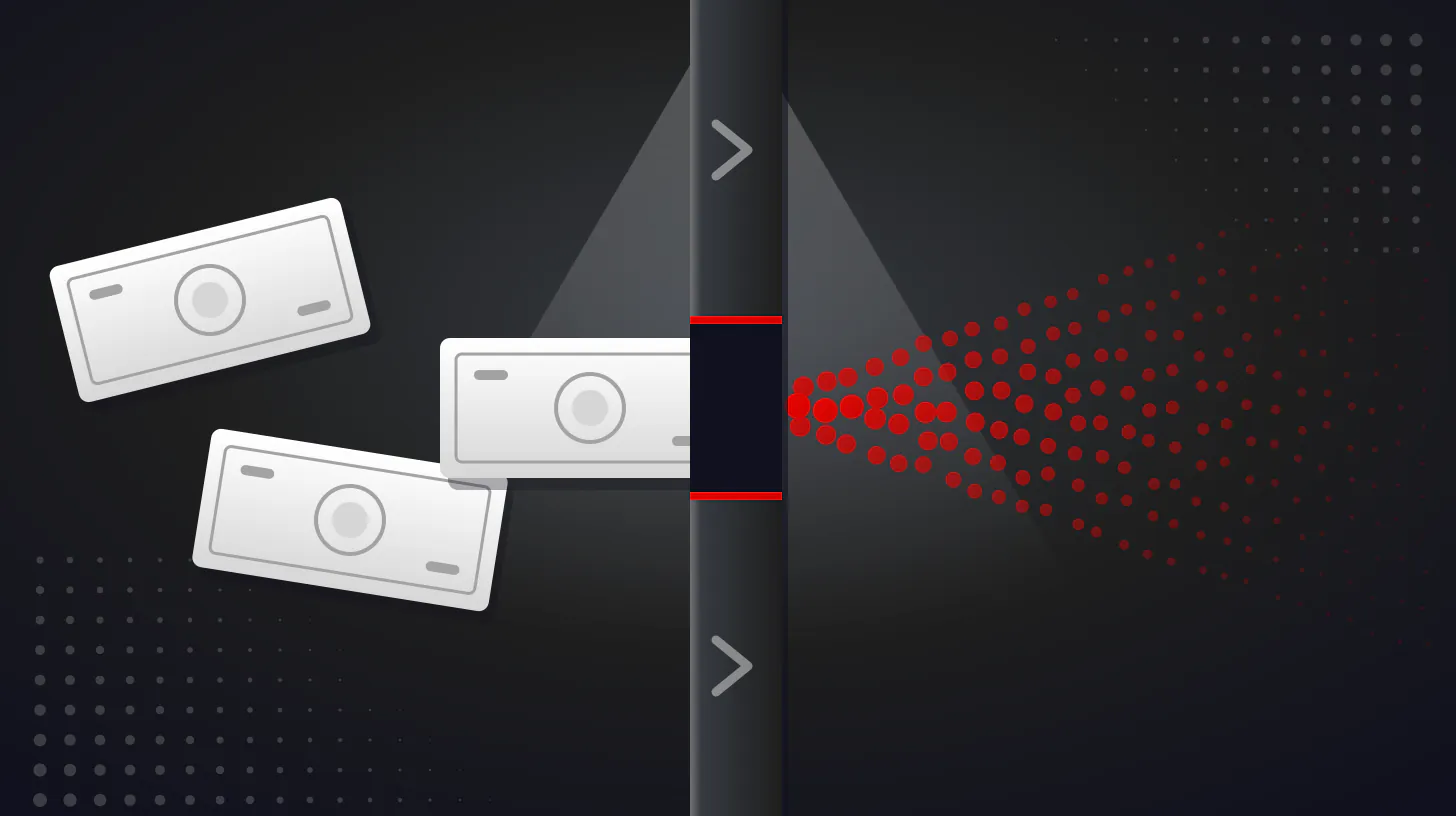
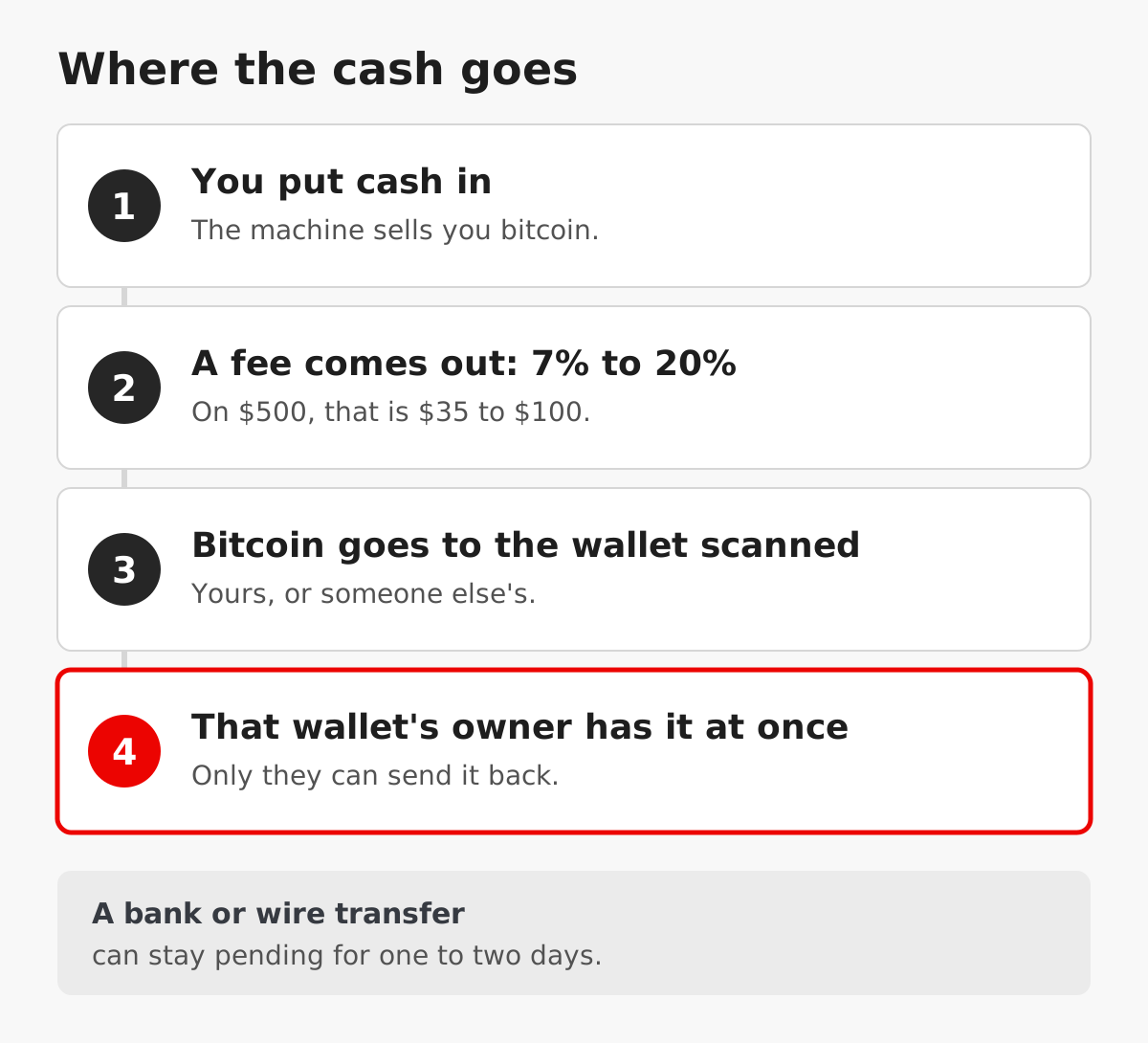
Cash that goes into a Bitcoin ATM does not wait in a pending queue the way a bank transfer does. The machine sells you bitcoin and delivers it to whatever wallet address was scanned, and from then on only the owner of that wallet can send it back.
So can you send money through a Bitcoin ATM? Yes, in the sense that your cash can end up as bitcoin in another person’s wallet. It is not a wire service, though, and the FBI’s Internet Crime Complaint Center logged 13,460 complaints and $389 million in losses tied to crypto ATMs and kiosks in 2025.
Can you send money through a Bitcoin ATM, or only buy bitcoin?
Strictly speaking, the machine only sells. The Financial Crimes Enforcement Network, the Treasury Department bureau known as FinCEN, described crypto kiosks in an Aug. 4, 2025, notice as “ATM-like devices” that exchange cash for virtual currency, most commonly bitcoin.
A bank ATM moves money in and out of your own account. At a kiosk, the notice says, a customer gives identification that can range from a phone number to a scan of a government-issued ID, then enters the address of the wallet that will receive the purchase and pays with cash or a card.
A wallet is the app or device that holds crypto. Its address normally comes as a QR code, which the FBI describes as a square barcode that a camera can scan and read.
That address can be “the customer’s own CVC wallet or that of a third party,” FinCEN wrote, using its abbreviation for convertible virtual currency. Scan your own code and you have bought bitcoin; scan someone else’s and you have paid them.
Not every machine allows the second option. Some operators require users to certify that the destination wallet belongs to them, a step FinCEN says could discourage fraud.
Byte Federal operates Bitcoin ATMs. ByteU’s guide to using a Bitcoin ATM walks through the screens, and an older Byte Federal News post on how to send money through a Bitcoin ATM covers buying to your own wallet first and sending from there.
What arrives on the other end
The person you pay receives bitcoin, never dollars, and needs a wallet to receive it.
FinCEN’s notice says the recipient “instantly owns” the crypto once the transfer is made. What it will be worth when that person sells is less certain, because the price of a bitcoin “can unpredictably increase or decrease over a short period of time,” according to Bitcoin.org.
Less arrives than you put in. Kiosk fees range from 7% to 20%, which FinCEN called high next to other ways of transferring funds. On $500 in cash, that comes to between $35 and $100.
State law can cap the amount as well. California bars kiosk operators from accepting more than $1,000 in a day from a customer, according to the notice, and ByteU’s breakdown of Bitcoin ATM fees and limits covers what you pay and why.
Why nobody can pull the payment back
Bitcoin has no mechanism for recalling a payment. “A Bitcoin transaction cannot be reversed, it can only be refunded by the person receiving the funds,” Bitcoin.org says.
Most cryptocurrencies run on open ledgers that anyone can use, so after a fraud there is often “no centralized authority who can easily reverse a transaction,” FinCEN wrote. A traditional bank or wire transfer, by the bureau’s account, can remain pending for one to two days before it settles.
The Federal Trade Commission tells consumers the same thing. “Cryptocurrency payments typically are not reversible,” its guidance says, and crypto typically comes without the legal protections that credit and debit cards carry.
Money can come back by another route. California ordered CoinFlip, a crypto ATM company with around 500 kiosks in the state, to pay over $4.8 million to Californians who were scammed, the state’s Business and Consumer Services Agency said in a Nov. 5, 2026, post.
That was restitution ordered from an operator after a state investigation, not a reversal of anyone’s bitcoin. The same post described kiosk transactions as “immediate, hard to track, and cannot be reversed.”
When the request came from someone else
The request usually reaches people before they reach the machine. Phone calls were the first contact in about 47% of the Bitcoin ATM fraud reports the FTC analyzed in a 2024 study, ahead of online ads or pop-ups and emails.
A caller may claim to be a bank, a government agency or a tech support desk. FinCEN says scammers normally supply the QR code themselves and often stay on the line, giving step-by-step instructions until the payment is complete.
The median loss reported to the FTC in the first half of 2024 was $10,000. In the FBI’s 2025 figures, people 60 and older filed 6,188 of the 13,460 kiosk complaints and reported about $257 million of the losses. Losses overall were up 58% from the year before, the report shows.
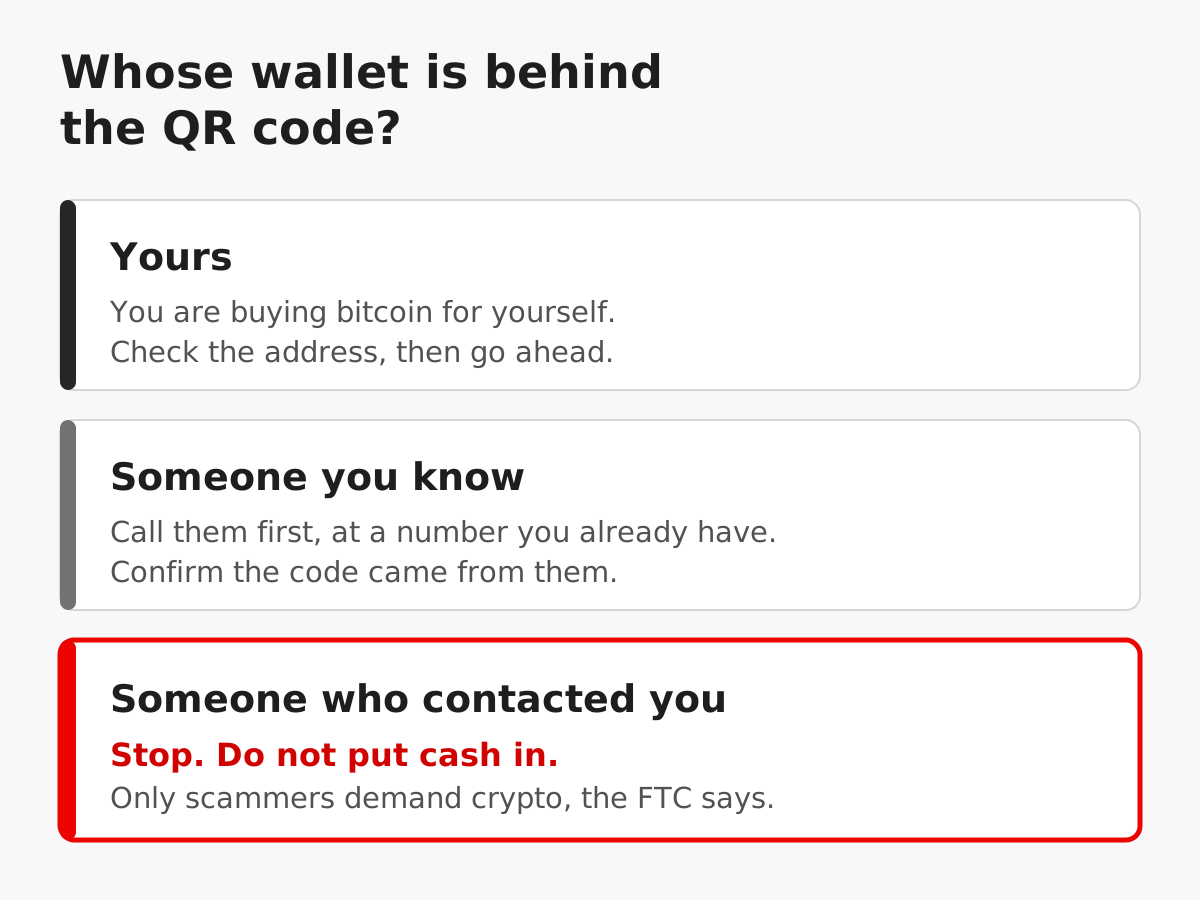
The FTC’s position leaves little room. “Only scammers demand payment in cryptocurrency,” its consumer guidance says, and no real business or government agency will tell you to use a Bitcoin ATM to protect your money or fix a problem.

The FTC, the FBI and FinCEN describe the same warning signs:
- A call, message or pop-up you did not expect.
- A QR code from someone you have never met.
- An order to withdraw cash, sometimes from investment or retirement accounts.
- Someone staying on the phone while you stand at the machine.
- Instructions to split the cash into smaller deposits or across several machines.
ByteU’s Bitcoin ATM safety article goes through how these scams work.
One rule for whose wallet gets scanned
Before any cash goes in, ask who controls the wallet behind the QR code.
If it is yours, in an app or on a device you set up, the machine is doing its ordinary job. If it belongs to a relative or a friend, reach that person yourself first, at a number you already have, and confirm the code came from them.
For everyone else, the FBI’s advice applies. Do not follow instructions from someone you have never met to scan a QR code and pay at a crypto ATM, the bureau says, and do not respond to a caller from an unknown number who claims to be a person you know and asks for crypto.
Bitcoin.org reaches the same rule from the other direction. Because payments are final, it says, take care to deal with people and organizations you “know and trust.”
When a request feels rushed, the FTC says to “Slow down” and talk with someone you trust before doing anything else.
If the cash has already gone in
Stop there, even if the caller says one more deposit will fix the problem. Scammers often try to extract repeated payments from the same person, according to FinCEN.
If the machine’s operator calls to say your transactions are consistent with fraud and advises you to stop, the FBI says to stop or cancel the transaction. Contact the operator yourself as well, and report what happened to the FTC at ReportFraud.ftc.gov and to the FBI at ic3.gov or a local field office.
ByteU’s guide to avoiding bitcoin scams lists other patterns to watch for.
Be wary of anyone who then offers to get the money back. The FBI’s 2025 report counted 10,516 complaints about recovery scams, including fictitious law firms that go after people who have already lost crypto.
This article is for educational purposes only and is not financial advice.
Sources
- Financial Crimes Enforcement Network, FinCEN Notice on the Use of Convertible Virtual Currency Kiosks for Scam Payments and Other Illicit Activity (FIN-2025-NTC1), Aug. 4, 2025.
- FBI Internet Crime Complaint Center, 2025 Internet Crime Report, page 53, accessed Nov. 10, 2026.
- Bitcoin.org, Some things you need to know, accessed Nov. 10, 2026.
- Federal Trade Commission, What To Know About Cryptocurrency and Scams, accessed Nov. 10, 2026.
- Federal Trade Commission, New FTC Data Shows Massive Increase in Losses to Bitcoin ATM Scams, Sept. 3, 2024.
- Federal Trade Commission, Bitcoin ATMs: A payment portal for scammers, Data Spotlight, Sept. 3, 2024.
- FBI Internet Crime Complaint Center, The FBI Warns of Fraudulent Schemes Leveraging Cryptocurrency ATMs and QR Codes to Facilitate Payment, Nov. 4, 2021.
- California Business and Consumer Services Agency, Holding Companies Accountable for Tech-Enabled Fraud, Nov. 5, 2026.
Frequently asked questions
Can a Bitcoin ATM transaction be reversed?
No. Bitcoin.org says a Bitcoin transaction cannot be reversed and can only be refunded by the person who received the funds. The FTC says cryptocurrency payments typically are not reversible, and FinCEN says there is often no central authority that can easily undo one after a fraud.
What does the other person get when I send money through a Bitcoin ATM?
Bitcoin, not dollars. FinCEN says the machine exchanges your cash for crypto and delivers it to the wallet address entered, and the recipient owns it instantly. The receiver needs a wallet, and Bitcoin.org says the price can rise or fall over a short period of time.
How much does it cost to send money through a Bitcoin ATM?
FinCEN's 2025 notice puts crypto kiosk fees at 7% to 20%, which it calls high next to other ways of transferring funds. On $500 in cash, that is $35 to $100. Fees vary by operator, so check the rate on the screen before you insert cash.
Is it a scam if someone tells me to send money through a Bitcoin ATM?
Treat it as one. The FTC says only scammers demand payment in cryptocurrency, and that real businesses and government agencies will never tell you to use a Bitcoin ATM to protect money or fix a problem. Hang up, then call the organization at a number you look up yourself.
Can I send bitcoin to someone else's wallet from a Bitcoin ATM?
Often, yes. FinCEN says the address entered can be the customer's own wallet or a third party's, though some operators require you to certify the wallet is yours. Scan another person's code only if you know them and have confirmed it with them directly.
Topics in this guide
All topicsUse what you learned
Choose the Byte Federal product that fits your next step.