

If you check a crypto address by glancing at its first few and last few characters, address poisoning is built to pass that glance. The scammer sends a small transaction to your wallet from an address whose beginning and end match one you already use, so the fake sits in your history and waits to be copied.
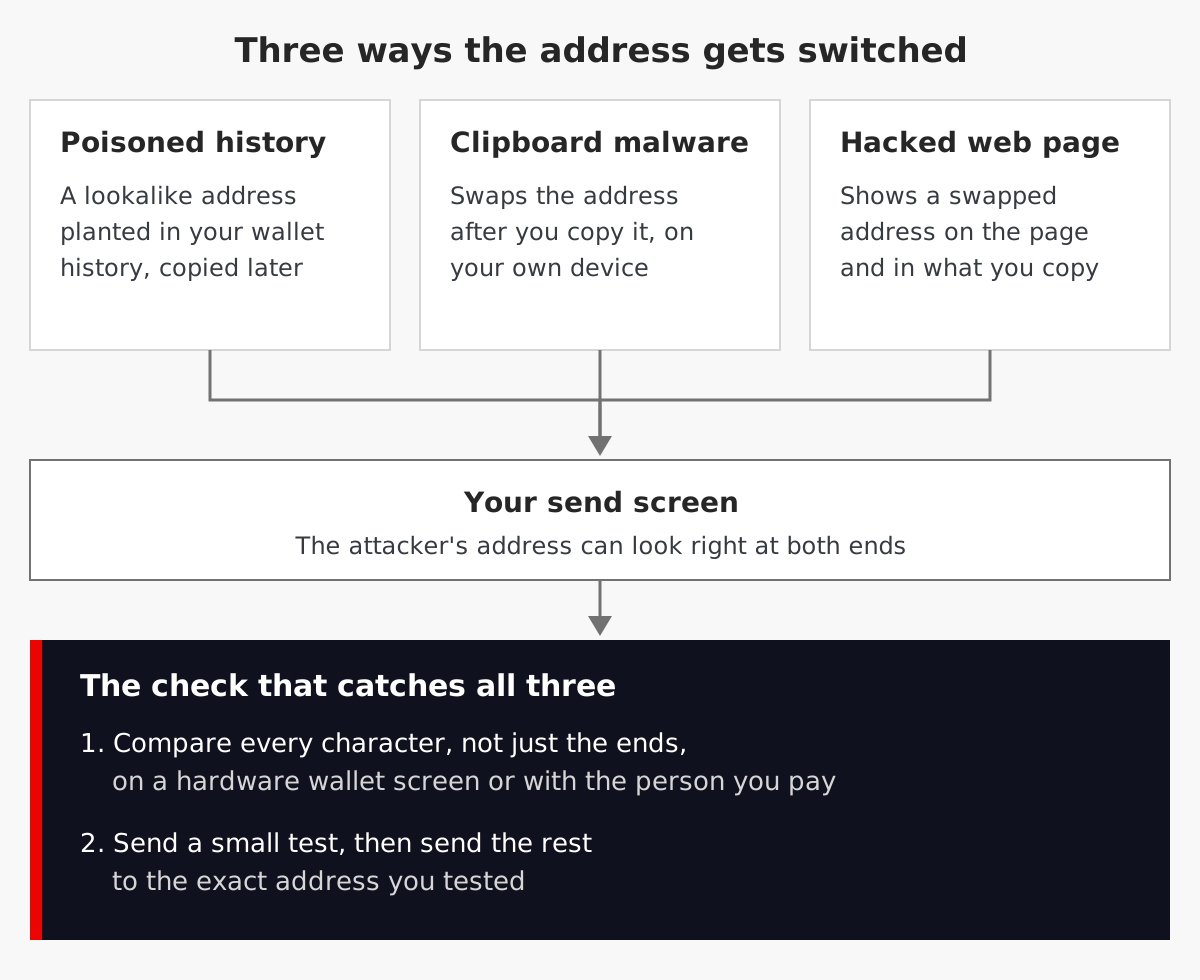
Malware can also rewrite an address after you copy it, and a hacked web page can show you the wrong one. On Nov. 16, 2026, a script served through Optimizely did that on the sites of 178 organizations, Ledger’s among them, according to the security firm Report URI.
Blockchain transactions are not reversible, Carnegie Mellon researcher Taro Tsuchiya said in January, so the check has to come before you send, and the same check catches all three swaps.
How address poisoning works
Chainalysis, a blockchain analytics firm, defines address poisoning as a scam that tricks people into sending funds “by manipulating their transaction history.”
The scammer generates a lookalike address and sends a small transfer from it, so it appears in your history next to the address you meant to pay.
Researchers at Carnegie Mellon University measured the scheme on Ethereum and Binance Smart Chain from July 2022 to June 2024. They counted 270 million attacks aimed at 17 million victims, and 6,633 incidents that cost people at least $83.8 million.
About one attack in 10,000 succeeds, according to the university’s CyLab. “It’s a numbers game,” said Nicolas Christin, one of the study’s authors.
Bitcoin users get the same treatment. Jameson Lopp, a co-founder of the bitcoin security company Casa, scanned the Bitcoin blockchain and found just shy of 48,000 suspected poisoning transactions between July 7, 2023, and Jan. 28, 2025.
Each one came from an address that shared its first four and last four characters with the address it was sent to, and Lopp found one that likely worked, a 0.1 BTC payment to a lookalike.
He blamed the way people and wallet apps handle addresses. People “rely on partial address matches, not checking the full string,” he wrote, while many wallet apps shorten addresses on screen and some users copy addresses straight from past transactions.
Malware can change the address after you copy it
Clipboard malware, also called a crypto clipper, runs on your own computer or phone.
Unit 42, the threat research team at Palo Alto Networks, described one strain in 2023 that went after bitcoin and Ethereum addresses. It “continually examines the victim’s clipboard” and swaps a copied wallet address for “a visually similar but adversary-controlled” one.
What you paste is then not what you copied, warns Trezor, which makes hardware wallets. MetaMask’s help center tells users to check every address again after pasting it and to keep anti-malware software installed and up to date.
A hardware wallet helps only as much as the check you do on it.
Researchers Nikolay Ivanov and Qiben Yan wrote in 2021 that “many users of hardware wallets elect to verify only a few symbols in the address.” They built a test attack around that habit and tried it on devices from three wallet makers, Trezor and Ledger among them.
A hacked web page can show you the wrong address
The Nov. 16 attack came through Optimizely, a company whose web experimentation tools load on customers’ pages as a script from its own servers.
Someone added code to customers’ Optimizely projects, and Optimizely’s network delivered it to visitors of those sites, Report URI and the security firm StepSecurity found.
Report URI checked 1,611 Optimizely scripts and found 188 infected, belonging to 178 organizations, and said the real number is likely higher. A sweep earlier that evening had counted 186 infected scripts, and crypto.news reported the figure as 186 websites.
Decrypt named Zoom, the BBC, HSBC and Ledger among the affected sites. For most of them the code ran for about 16 hours, StepSecurity said.
The script looked for valid addresses on Bitcoin and seven other networks and replaced them on the page and in anything a visitor copied, according to Report URI.
The replacements were the attacker’s own working addresses, so a wallet’s typo check had nothing to flag.

Ledger said on X that the code was no longer being served from its website and that “this incident does not affect the security architecture of Ledger devices.” Its security team, Ledger Donjon, said private keys “remain protected by your Ledger device.”
Report URI counted about $7,040 reaching the attacker’s wallets by the evening of Nov. 16, and Decrypt reported that a later Report URI update put the total near $7,150.
Galaxy Digital’s Alex Thorn estimated that only about $2,300 came from victims, StepSecurity reported, and no count so far is a confirmed tally of what visitors lost.
Optimizely said an unauthorized party “exploited a vulnerability in the Experimentation account signup flow.” StepSecurity advises anyone who copied a wallet address from an affected site between roughly 04:00 and 21:00 UTC that day to treat it as compromised.
Check every character against a second screen
Each of these attacks changes the address on the screen you are already using. You catch them by comparing the whole address with a copy the attacker could not touch.
A hardware wallet shows every payment on its own small display before you approve it.
“Malware on your computer or phone can change what you see on those screens, but it cannot change what your Trezor shows you,” Trezor says. Ledger says its device signs only what you approve on its screen.
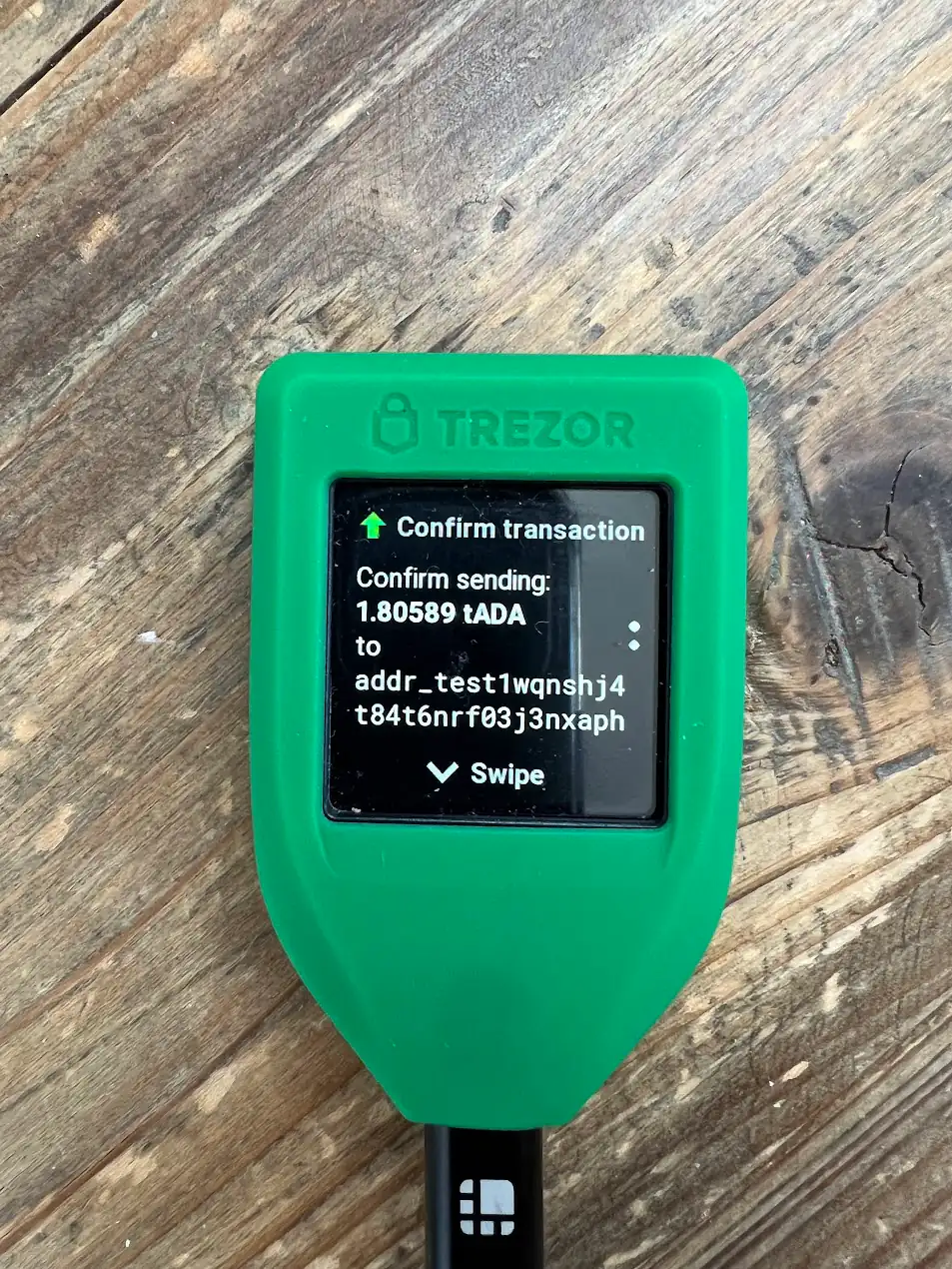

That screen shows where the money is going, but it “can’t tell you whether an address someone gave you is the right one,” according to Trezor. If the address reached you through an infected page or a doctored paste, the device will show the attacker’s address just as clearly.
The other copy has to come from the person you are paying. Ryder, another hardware wallet maker, advises confirming a large payment with the recipient through a separate channel, such as a call or a message in a different app, with the address read aloud.
Check every character, not only the ends, as Ledger and Trezor both advise.
Trezor also says not to copy addresses from your transaction history or a block explorer, and Lopp suggests saved address labels or contacts instead.
Send a small test, then send the rest to that same address
Chainalysis and Trezor both recommend sending a small test payment before a large one, though Trezor notes that this means paying the network fee twice.
The test protects you only if the full payment goes to the address you tested.
In the case Chainalysis studied, a victim sent what looked like a test on May 3, 2024, and minutes later sent about $68 million in wrapped bitcoin on Ethereum to a lookalike that matched the real address in its first six characters. The scammer sent the money back on May 9.
On Dec. 20, 2025, a trader sent a 50 USDT test to the right address at 3:06 UTC. At 3:32 UTC, 49,999,950 USDT, nearly $50 million, went to a lookalike that matched the first five and last four characters, The Block reported, citing the trackers Lookonchain and Etherscan.
The trader most likely copied the fake from the wallet’s history, where apps often hide the middle characters behind an ellipsis, according to The Block.
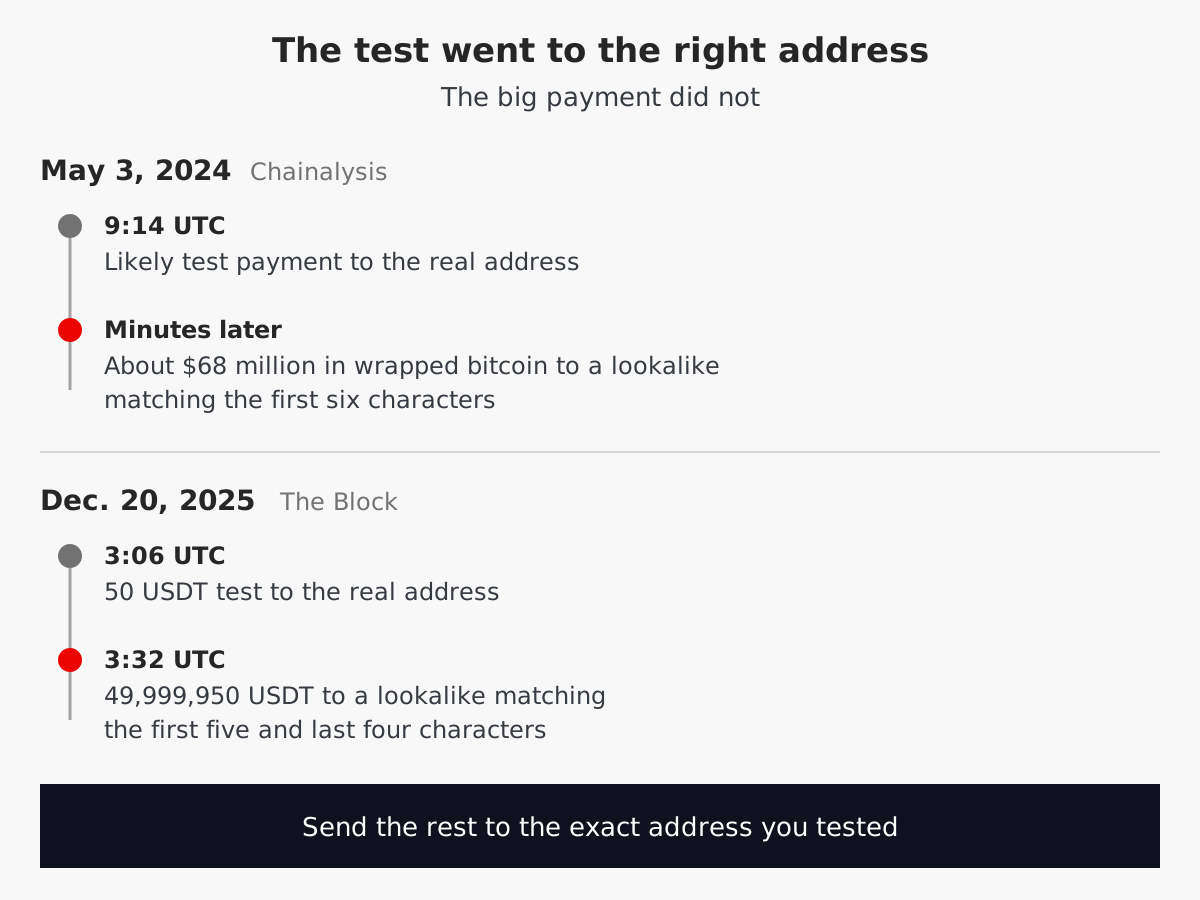
Send the remainder to the exact address from your test, taken from your own records rather than copied again.
If the address was switched
The FTC’s advice after paying a scammer in crypto is to contact the exchange or ATM operator immediately, say the transaction was fraudulent and ask for the money back.
Report it to the FTC at ReportFraud.ftc.gov and to the FBI’s Internet Crime Complaint Center at ic3.gov.
If a message rushed you into the payment, ByteU’s guides to crypto phishing and avoiding bitcoin scams cover what to check next.
Report URI’s advice to Nov. 16 visitors works for any payment: “If the address you pasted doesn’t match the one you meant to pay, it may have been swapped.”
Some images in this article were generated with AI.
This article is for educational purposes only and is not financial advice.
Sources
- Report URI, “World’s Largest Brands Infected With Malware Via Optimizely,” Nov. 16, 2026, updated Nov. 17, 2026.
- StepSecurity, “OPTIMJACK: Optimizely-Hosted Scripts Loaded a Crypto Clipper and Card Skimmer on 178 Organizations,” Nov. 17, 2026, updated Nov. 20, 2026.
- Decrypt, “Optimizely Hack Hijacked Ledger, BBC and 176 Other Sites to Swap Crypto Wallet Addresses,” Nov. 17, 2026.
- crypto.news, “Optimizely supply chain attack targets crypto wallets across 186 websites,” Nov. 17, 2026.
- Unchained, “Hacker Rigs Optimizely Scripts to Reroute Crypto Payments; Optimizely Cites a Signup Bug,” Nov. 17, 2026.
- TokenPost, report on Ledger’s statement, Nov. 17, 2026.
- Chainalysis, “Anatomy of an Address Poisoning Scam,” Oct. 23, 2024.
- Taro Tsuchiya, Jin-Dong Dong, Kyle Soska and Nicolas Christin, “Blockchain Address Poisoning,” USENIX Security Symposium, 2025.
- Carnegie Mellon CyLab, “CyLab study uncovers 270 million crypto phishing attempts,” Jan. 7, 2026.
- Jameson Lopp, “Bitcoin Address Poisoning Attacks,” April 6, 2025.
- The Block, “Crypto trader loses $50 million in address poisoning attack, offers $1 million bounty for return,” Dec. 20, 2025.
- Unit 42, Palo Alto Networks, “CryptoClippy Speaks Portuguese,” April 5, 2023.
- MetaMask Help Center, “Clipboard hacking,” accessed Nov. 20, 2026.
- Nikolay Ivanov and Qiben Yan, “EthClipper: A Clipboard Meddling Attack on Hardware Wallets with Address Verification Evasion,” IEEE CNS, 2021.
- Trezor, “Trezor’s Trusted Display: Verify every address on your device,” accessed Nov. 20, 2026.
- Trezor, “What are address poisoning attacks and how to avoid them,” accessed Nov. 20, 2026.
- Ledger Academy, “What Are Address Poisoning Attacks in Crypto and How to Avoid Them?,” updated Aug. 29, 2025.
- Ryder, “How to verify a public address before sending crypto,” accessed Nov. 20, 2026.
- Federal Trade Commission, “What To Do if You Were Scammed,” June 2026.
- FBI Internet Crime Complaint Center, ic3.gov, accessed Nov. 20, 2026.
Frequently asked questions
What is address poisoning?
It is a scam in which someone sends a small transaction to your wallet from an address that matches the first and last characters of one you use. If you later copy that lookalike from your history, your payment goes to the scammer. Chainalysis defines it as tricking people by manipulating their transaction history.
Does address poisoning happen with bitcoin?
Yes. Jameson Lopp, a co-founder of Casa, found just shy of 48,000 suspected poisoning transactions on the Bitcoin blockchain between July 7, 2023, and Jan. 28, 2025, each sent from an address sharing the first and last four characters of the target. He found one likely successful attack, a 0.1 BTC payment.
Does a hardware wallet protect me from clipboard malware?
It helps if you use its screen. Trezor says malware on a computer or phone cannot change what its device shows, but the screen cannot tell you whether the address someone gave you is right. Compare every character with an address the person you pay confirmed through another channel.
Were Ledger devices affected by the Optimizely attack?
Ledger said the incident did not affect the security architecture of its devices, and its security team said private keys remain protected by the device. The malicious script ran on Ledger's public website on Nov. 16, 2026, one of 178 organizations whose sites Report URI found infected.
Can I get crypto back after sending it to a poisoned address?
Blockchain payments are not reversible, so act fast. The FTC says to contact the exchange or ATM operator immediately, report the transaction as fraudulent and ask for it to be reversed and refunded. Then report it at ReportFraud.ftc.gov and to the FBI at ic3.gov.