

A text or call that gets your name, your home address and your account balance right can still be crypto phishing. Those details have been taken from crypto companies more than once, and scammers use them to sound like the support desk.
You don’t have to work out whether a message is fake. The Federal Trade Commission’s rule is to “contact the company using a phone number or website you know is real,” not the one in the message. All you need is the company’s own app or a phone number you look up yourself.
The FBI’s Internet Crime Complaint Center counted 191,561 phishing complaints in 2025, more than for any other crime type. Reported losses rose to about $215.8 million from about $70 million in 2024.
What crypto phishing is and how it reaches you
Crypto phishing is a message or call from someone posing as your exchange, wallet maker or card provider to get your login details, your recovery phrase or your coins. The FBI’s definition of phishing covers “unsolicited email, text messages, and telephone calls purportedly from a legitimate company.”
The bureau described the crypto version in a public warning on Aug. 1, 2024. Scammers posing as exchange employees call or message without warning, say the account has a problem or is under attack, and press for login details, a click on a link or identifying information. Once they are in the account, they take the crypto.
Paper mail counts too. Ledger, which makes hardware wallets, says its customers have received “physical letters in the mail” that ask them to scan a QR code or visit a website.
Where the scammer got your name, address and balance
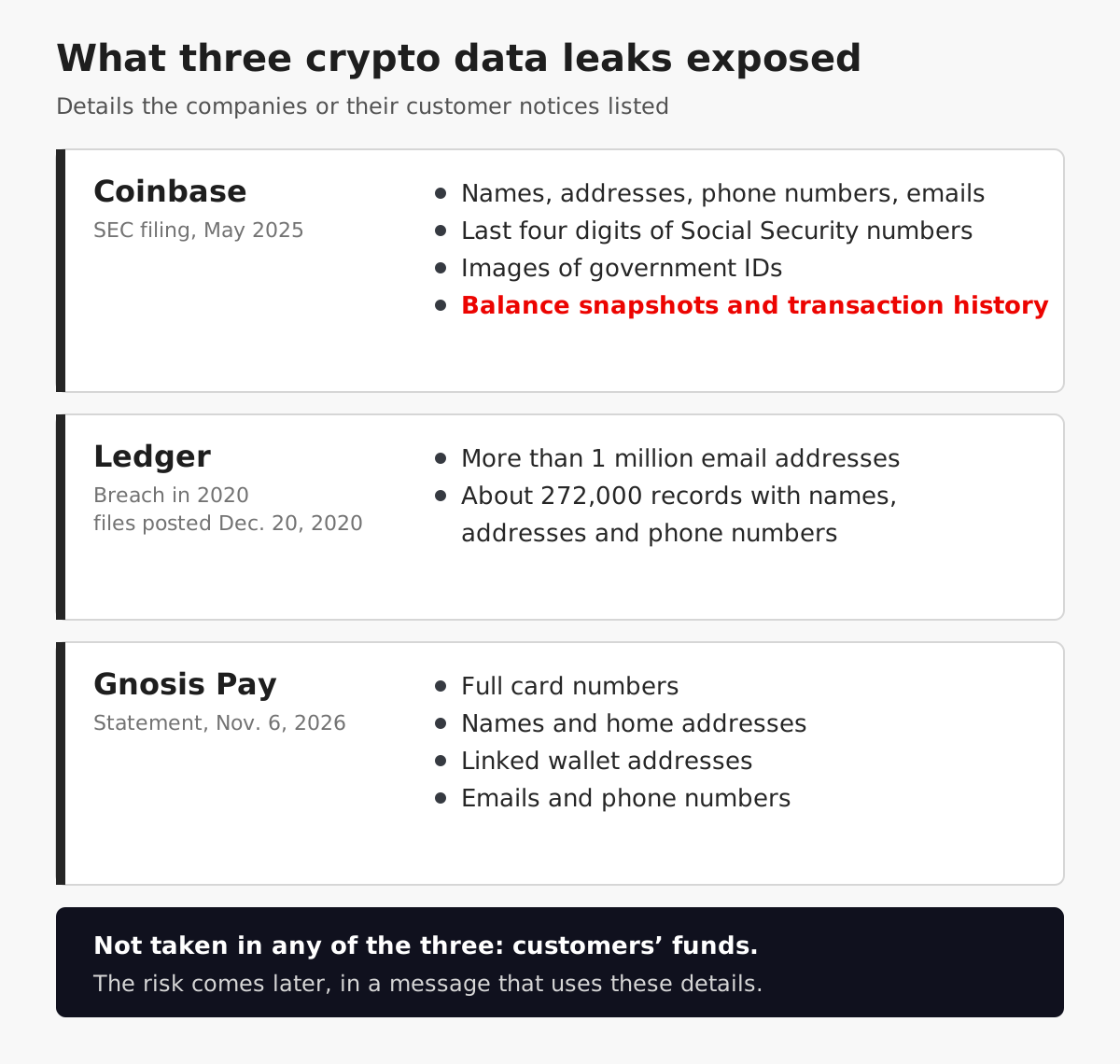
In May 2025, Coinbase told the Securities and Exchange Commission that an unknown party appeared to have paid support contractors or employees outside the United States to pull customer information from its internal systems.
The filing lists names, addresses, phone numbers and emails, the last four digits of Social Security numbers, masked bank account numbers and images of government IDs. It also lists account data, including “balance snapshots and transaction history.”
No passwords or private keys were taken, the company said. It warned that the information could be used in “social-engineering attempts,” which are tricks aimed at a person instead of a computer. Coinbase estimated its costs, including repayments to customers who sent money to the thief, at $180 million to $400 million.
Buying a wallet was enough to land on a similar list. Ledger said an outsider reached its e-commerce and marketing database in 2020, and on Dec. 20, 2020, the stolen files were posted in a forum. They held more than 1 million email addresses and about 272,000 customer records with names, addresses and phone numbers.
The company wrote in January 2021 that “criminals are attacking Ledger customers with phishing attempts” and that it had shut down 216 sites.

The newest case is Gnosis Pay, a crypto card provider. It said on Nov. 6, 2026, that a breach detected on Nov. 3 had exposed “certain customer information” from the system behind its own-brand cards, and that funds were not affected.
Gnosis Pay did not publish the list. Notices sent to customers and reviewed by Cointelegraph named full card numbers, names, home addresses, linked wallet addresses, emails and phone numbers.
Not every claimed leak has been confirmed. A seller offered what it called records of 335 million Binance users for $900,000, BleepingComputer reported on Nov. 9, 2026. Binance told the site it had found no evidence of a breach and that the claim is likely a scam.
What a real company will not ask for
Gnosis Pay told its customers to be suspicious of any unexpected email, text, call or letter, “even if it includes your real details or a real purchase.”
The company said it will never ask for a seed phrase, private keys, a PIN or a full card number. It will not ask anyone to verify their identity again by email or text, or to move funds by email, text or phone. A seed phrase, also called a recovery phrase, is the list of words that restores a crypto wallet.
“Ledger will never ask you for your 24 words,” that company says, and it does not contact customers by text message or phone call. Anyone who gets the phrase “has full access to any account that has been created using it.”
Binance’s advice, reported on Nov. 9, 2026, was the same. Never share passwords, two-factor codes, seed phrases or private keys.
Phishing messages tell a story to get a click, the FTC says. It may be a suspicious log-in attempt, a problem with your account or payment details, or an invoice you don’t recognize.
“Only scammers demand payment in cryptocurrency,” according to the agency, and a demand to send crypto to protect your money is always a scam.
Check any message in three steps
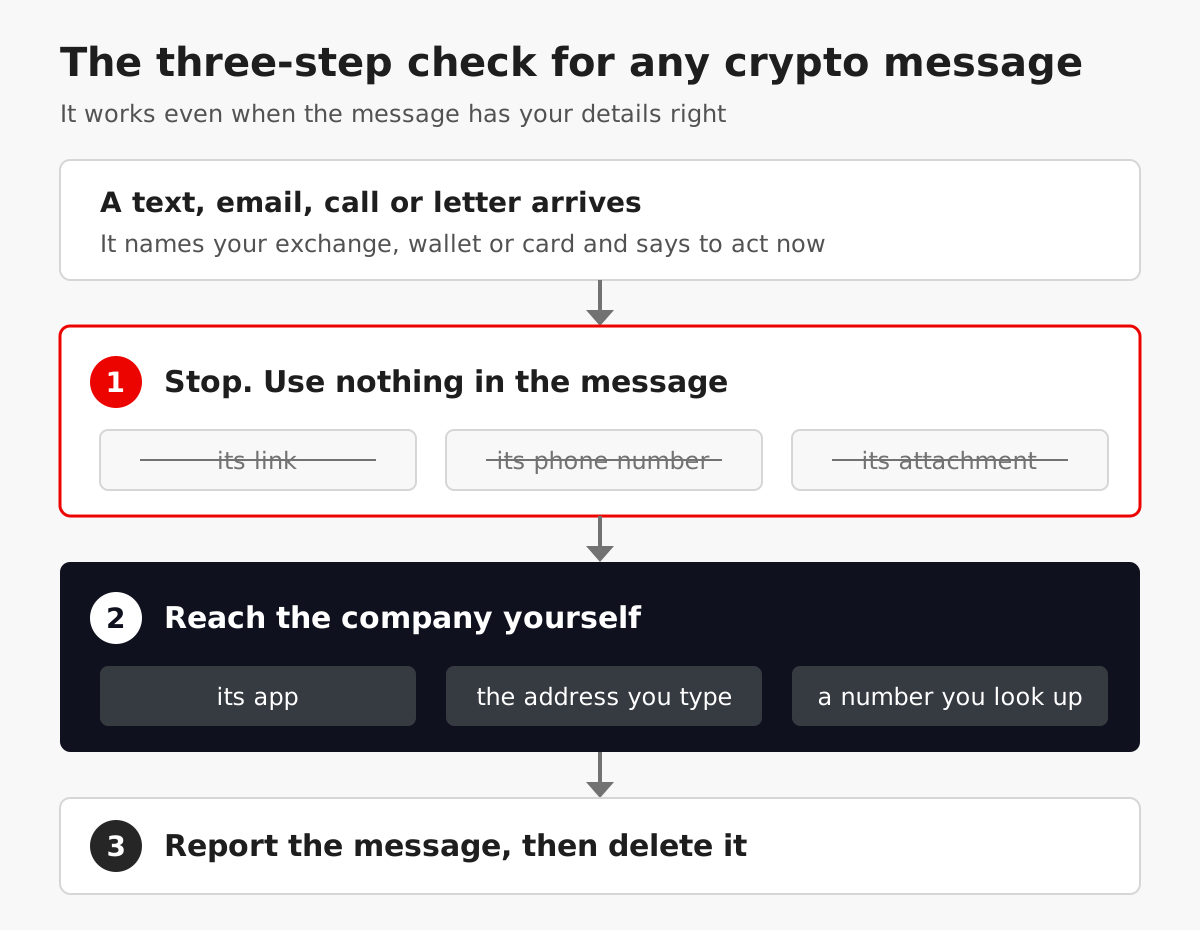
The advice from the FBI and the FTC comes down to three steps, and they work even when the message has every detail right.
- Stop. Don’t click the link, open the attachment, reply or call the number in the message. The FBI says to end a call about an account problem even if it seems official or urgent.
- Reach the company yourself. Open its app, type its web address or call a phone number you looked up. Don’t use a number the caller gives you.
- Report the message, then delete it.
Turn on multi-factor authentication before you need it. The FTC says it “makes it harder for scammers to log in to your accounts” if they get your username and password.
If you already clicked, shared a password or sent money
The FTC’s page on what to do after a scam, dated June 2026, matches the step to what the scammer got.
- A username and password: create a new, strong password, change it anywhere else you use it and turn on two-factor authentication.
- A click on a link or attachment: update your security software, run a scan and remove anything it flags.
- A Social Security, credit card or bank account number: go to IdentityTheft.gov.
- A crypto payment: contact the exchange or ATM operator immediately, say the transaction was fraudulent and ask them to reverse it and refund your money.
If you typed or read out a recovery phrase, treat that wallet as exposed and contact the wallet maker through its official support channels.
The FBI also says to be wary of anyone who claims they can recover lost cryptocurrency.
Where to report crypto phishing
Forward phishing emails to reportphishing@apwg.org and texts to SPAM (7726). Report the attempt to the FTC at ReportFraud.ftc.gov and to the FBI at ic3.gov, with any transaction details you have.
Tell the company being imitated, through its app or website. If money moved, tell the exchange or ATM operator you used.
ByteU’s guide to avoiding bitcoin scams covers the other common schemes. A friendly stranger who texts a “wrong number” is running a slower one, known as pig butchering. And when a caller sends you to a Bitcoin ATM, the scam began with the call, as ByteU’s article on why the scam doesn’t start at the kiosk explains. Byte Federal operates Bitcoin ATMs.
This article is for educational purposes only and is not financial advice.
Sources
- Coinbase Global, Form 8-K, Item 1.05, filed with the SEC, May 2025.
- Gnosis Pay, “Data breach on the legacy system powering Gnosis Pay-branded cards,” Nov. 6, 2026.
- Cointelegraph, report on the Gnosis Pay breach notifications, Nov. 6, 2026.
- Ledger, statement on its July 2020 e-commerce and marketing data breach, July 29, 2020.
- Ledger, update on the data breach and phishing attacks, Jan. 13, 2021.
- Ledger, status page on phishing campaigns, accessed Nov. 10, 2026.
- BleepingComputer, “Binance denies data breach after alleged ShinyHunters claims,” Nov. 9, 2026.
- FBI Internet Crime Complaint Center, 2025 IC3 annual report, accessed Nov. 10, 2026.
- FBI, “FBI Warns of Scammers Impersonating Cryptocurrency Exchanges,” Aug. 1, 2024.
- Federal Trade Commission, “How To Recognize and Avoid Phishing Scams,” September 2022.
- Federal Trade Commission, “What To Know About Cryptocurrency and Scams,” May 2022.
- Federal Trade Commission, “What To Do if You Were Scammed,” June 2026.
Frequently asked questions
What is crypto phishing?
It is a message or call from someone posing as your exchange, wallet maker or card provider to get your login details, recovery phrase or coins. The FBI warned on Aug. 1, 2024, that scammers pose as exchange employees, say an account is under attack and press for login details.
How do scammers know my name, address and balance?
Often from data taken from crypto companies. Coinbase told the SEC in May 2025 that stolen customer data included names, addresses and balance snapshots. Ledger said about 272,000 customer records with names, addresses and phone numbers were stolen in 2020. Real details do not make a message real.
Will a crypto exchange call me about a problem with my account?
Treat any unexpected call that way as a scam attempt. The FBI says to ignore unsolicited calls or messages about account problems, even if they seem official or urgent, end the call and contact the exchange through its official phone number, not one the caller gives you.
What should I do if I clicked a crypto phishing link?
The FTC says to update your security software, run a scan and remove anything it flags. If you entered a username and password, create a new, strong password, change it anywhere else you use it and turn on two-factor authentication. If you sent crypto, contact the exchange or ATM operator immediately.
How do I report a crypto phishing email or text?
Forward the email to reportphishing@apwg.org and the text to SPAM (7726). Report it to the FTC at ReportFraud.ftc.gov and to the FBI at ic3.gov, with any transaction details. Also tell the company the message imitated, through its app or website.