
Table of contents
- Do bitcoin ATMs require ID? Federal rules put the duty on the operator
- The dollar amounts that bring more questions
- States have added ID and limit rules of their own
- Who keeps your ID, and for how long
- Why the machine may ask what the purchase is for
- What to do when the screen asks for your ID
- Sources
A Bitcoin ATM asks who you are before it takes a single bill. FinCEN, the Treasury Department’s financial crimes bureau, said in an Aug. 4, 2025, notice that ID at a kiosk “can range from a phone number to a scan of a government-issued ID.”
The short answer to “do bitcoin ATMs require ID” is yes, because federal rules make the company that runs the machine verify its customers.
What the screen asks for depends on the operator, the amount and the state. Whatever you hand over stays with the operator, which federal rules require to keep its records for five years.
Do bitcoin ATMs require ID? Federal rules put the duty on the operator
FinCEN settled the main question in guidance issued May 9, 2019. Anyone who runs a crypto kiosk that takes cash and sends back the same value in virtual currency “qualifies as a money transmitter,” the bureau wrote. That person must follow its rules for money transmitters.
Those rules come from the Bank Secrecy Act, the federal anti-money laundering law. One of them, 31 CFR 1022.210, makes every money services business run a written program against money laundering. The program must cover verifying customer identification, filing reports, keeping records and answering law enforcement requests.
The rule names no dollar amount at which a kiosk must scan a license. It says the program must be “commensurate with the risks” of the business, so one machine may accept a phone number for a small purchase while another scans a government ID before the first dollar.
FinCEN has said which end of that range worries it. Its 2025 notice lists red flags of an operator that is not following the law. One is a kiosk business “that advertises the ability for customers to conduct transactions without identification, or with only a phone number or email address.”
The dollar amounts that bring more questions
Federal reporting rules explain why a larger purchase draws more questions than a small one.
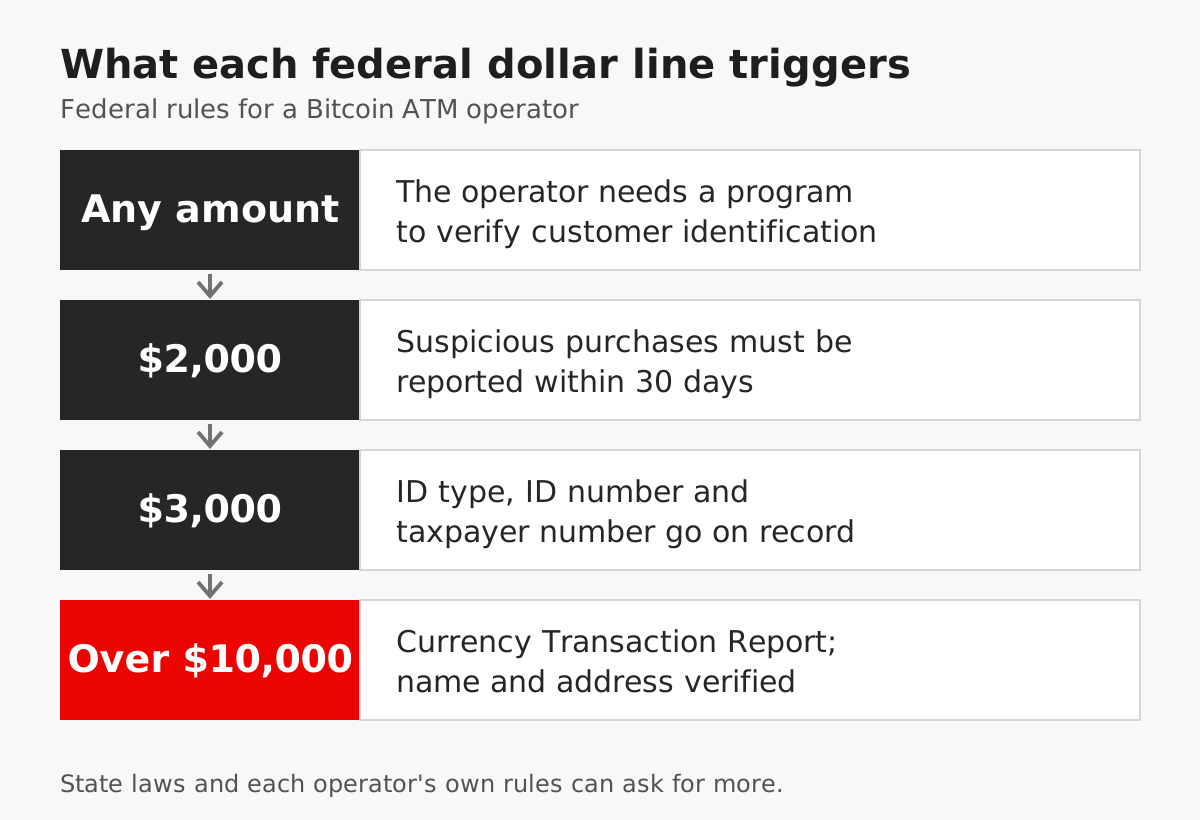
At $2,000, a money services business must report a transaction it knows or suspects is tied to a crime. It has 30 calendar days to file the report.
At $3,000, the records rule for money transfers applies, and FinCEN’s 2019 guidance says crypto transactions count as transfers. For a walk-in who is not an established customer, 31 CFR 1010.410 tells the business to check ID. It must record “the type of identification reviewed, and the number of the identification document (e.g., driver’s license),” plus a taxpayer number such as a Social Security number.
Above $10,000 in cash, the business files a Currency Transaction Report and must first “verify and record the name and address of the individual,” according to 31 CFR 1010.312. Purchases can be added together to reach that line. Breaking one into smaller pieces to stay under it is called structuring, and federal law bans it.
States have added ID and limit rules of their own
Some states have kiosk laws of their own, written to deter crime and protect customers from fraud, FinCEN’s notice says.
California’s rule is a cap. Under Financial Code section 3902, in effect since Jan. 1, 2024, an operator may not accept or dispense more than $1,000 in a day from or to a customer through a kiosk.
West Virginia wrote the ID check into its code. A law that took effect March 14, 2026, tells each licensed operator to “obtain a copy of a government-issued identification card that identifies each customer.” It caps daily purchases at $1,000 for a customer who has just signed up and $10,000 for one the operator already has on file.
Minnesota banned the machines. Since Aug. 1, 2026, state law has barred anyone from installing or operating a virtual currency kiosk.
Operators have tightened on their own too. Bitcoin Depot, then the largest operator in North America, said on Feb. 24, 2026, that it had begun requiring identification “for every transaction at its kiosks.” The company filed for Chapter 11 bankruptcy in May 2026 and took its kiosk network offline, Bitcoin Magazine reported.
Who keeps your ID, and for how long
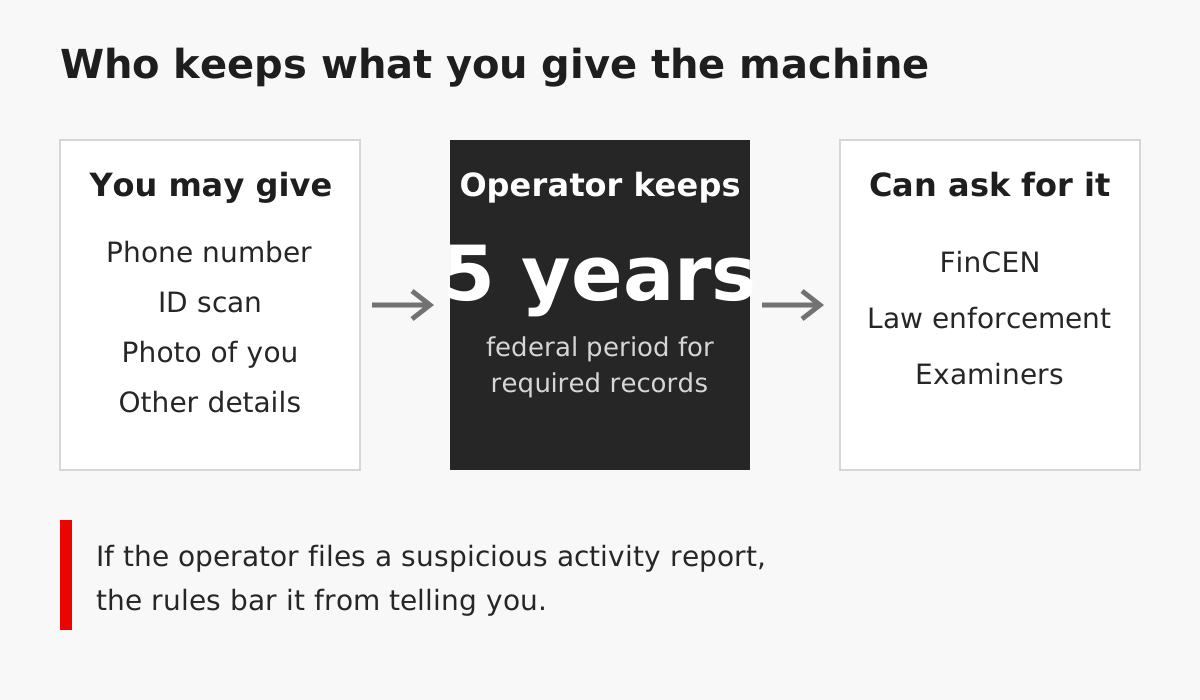
The operator keeps it. The duty to check customers and keep records belongs to the money services business. “All records that are required to be retained by this chapter shall be retained for a period of five years,” 31 CFR 1010.430 says.
Those records are open to the government. An operator that files a suspicious activity report keeps the report and its supporting documents for five years from the filing date. It must hand the documents to FinCEN, to law enforcement or to its examiners when they ask. The customer is not told, because the same rule bars the business from revealing that a report exists.
The federal rules cited here set the five-year period but do not say how an ID image must be stored. For that, read the operator’s privacy policy before you scan anything.
Byte Federal operates Bitcoin ATMs. Its policy, effective May 22, 2025, lists what it collects to verify identity: “Full legal name, date of birth, address, email, phone number, Social Security number, images of government-issued ID, photographs (selfies), other documents requested by compliance team.”
The policy says the company must in most cases keep identity documents and transaction data “for a minimum of five to seven years after the end of your relationship with us.” It also says the company “does not sell personal information.” Its guide to fees and limits says “every transaction at a Byte Federal machine requires identity verification, regardless of amount.”
Why the machine may ask what the purchase is for
A question about the purpose of a purchase is a fraud check. West Virginia’s law tells operators to screen each purchase before it goes through, including by “establishing the nature and purpose of the transaction.” They may hold a risky purchase for up to 72 hours.
The complaint numbers show why. The FBI’s Internet Crime Complaint Center got more than 10,956 complaints about crypto kiosks in 2024, with reported losses of about $246.7 million, FinCEN said.
The trouble usually starts away from the machine. Phone calls were the first contact in about 47% of the kiosk fraud cases reported to the Federal Trade Commission. FinCEN said scammers send the victim a QR code for a wallet they control, then stay on the line “providing step-by-step instructions until the payment is completed.”
ID records help operators catch the pattern, since FinCEN tells them to watch for several accounts tied to one phone number or wallet address. ByteU’s guide to avoiding bitcoin scams lists the warning signs a buyer can spot.
What to do when the screen asks for your ID
Bring a government-issued photo ID, such as a driver’s license or passport, and your mobile phone. This site’s page on how to use a Bitcoin ATM lists both, and ByteU’s step-by-step guide walks through the screens.
Use your own ID and send the bitcoin to your own wallet. Some operators make customers confirm that the receiving wallet is theirs, FinCEN said. Bitcoin Depot said its every-purchase check was meant to stop “account sharing, identity theft, and account takeover attempts.”
Treat a machine that promises no ID as a warning, as FinCEN does.
If someone you have not met sent you to the machine, stop before you scan anything. “Only scammers demand payment in cryptocurrency,” the FTC says. Its guidance on Bitcoin ATMs adds, “Never withdraw cash in response to an unexpected call or message.” Report it at ReportFraud.ftc.gov and ic3.gov, and tell the operator.
In Minnesota, operators have until Dec. 31, 2026, to remove their kiosks from anywhere the public can see or reach them.
This article is for educational purposes only and is not financial advice.
Sources
- FinCEN, “Application of FinCEN’s Regulations to Certain Business Models Involving Convertible Virtual Currencies,” FIN-2019-G001, May 9, 2019.
- FinCEN, “FinCEN Notice on the Use of Convertible Virtual Currency Kiosks for Scam Payments and Other Illicit Activity,” FIN-2025-NTC1, Aug. 4, 2025.
- Code of Federal Regulations, 31 CFR 1022.210, anti-money laundering programs for money services businesses, accessed Nov. 10, 2026.
- Code of Federal Regulations, 31 CFR 1022.320, suspicious transaction reports by money services businesses, accessed Nov. 10, 2026.
- Code of Federal Regulations, 31 CFR 1010.410, records for transmittals of funds, accessed Nov. 10, 2026.
- Code of Federal Regulations, 31 CFR 1010.312, identification required, accessed Nov. 10, 2026.
- Code of Federal Regulations, 31 CFR 1010.430, nature of records and retention period, accessed Nov. 10, 2026.
- California Legislative Information, Financial Code section 3902, effective Jan. 1, 2024.
- West Virginia Legislature, West Virginia Code section 32A-2-8c, virtual currency kiosk requirements, and House Bill 5353 history, 2026.
- Minnesota Legislature, Senate File 3868, Laws 2026, chapter 65, approved May 5, 2026.
- Bitcoin Depot, “Bitcoin Depot Introduces New Compliance Policy Requiring ID Verification at Every Transaction,” Feb. 24, 2026.
- Bitcoin Magazine, “Bitcoin Depot (BTM) Stock Falls 80% As Company Files for Chapter 11 Bankruptcy,” May 18, 2026.
- Byte Federal, “Privacy Policy,” effective May 22, 2025.
- Federal Trade Commission, “Bitcoin ATMs: A payment portal for scammers,” Sept. 3, 2024.
- Federal Trade Commission, “What To Know About Cryptocurrency and Scams,” May 2022.
Frequently asked questions
Can you use a Bitcoin ATM without ID?
Not at an operator that follows federal rules. FinCEN treats kiosk operators as money transmitters that must verify customer identification, and its 2025 notice says ID can range from a phone number to a scan of a government-issued ID. It lists a kiosk that advertises purchases without identification as a red flag.
What ID do you need to use a Bitcoin ATM?
It depends on the operator, the amount and the state. Byte Federal's site says to bring a valid government-issued photo ID, such as a driver's license or passport, and your mobile phone. West Virginia law requires operators to obtain a copy of a government-issued identification card for each customer.
Why does a Bitcoin ATM ask for a Social Security number?
Federal recordkeeping rules for transfers of $3,000 or more tell a money transmitter to record a walk-in customer's ID type and number and a taxpayer identification number, such as a Social Security number. Operators may also collect it for their own identity checks, so read the privacy policy.
How long does a Bitcoin ATM operator keep my ID?
Federal rules say records an operator is required to keep must be retained for five years, and suspicious activity reports and their supporting documents for five years from filing. Operators can set longer periods. Byte Federal's privacy policy says a minimum of five to seven years after the relationship ends.
Is a Bitcoin ATM that does not ask for ID a bad sign?
FinCEN says so. Its Aug. 4, 2025, notice lists a kiosk business that advertises transactions without identification, or with only a phone number or email address, among the red flags of an operator that may not be following federal anti-money laundering rules.
Topics in this guide
All topicsUse what you learned
Choose the Byte Federal product that fits your next step.