
Table of contents
- How the FBI followed Colonial Pipeline’s ransom
- Every bitcoin payment sits on a public ledger
- How analysts link one address to the next
- Can bitcoin be traced to a person? Usually at an exchange
- Where the trail gets harder to follow
- Tracing is not the same as getting money back
- What to do if a scammer took your bitcoin
- Sources
The ransomware gang that hit Colonial Pipeline in May 2021 lost most of its bitcoin ransom a month later, to agents who had followed the payment across Bitcoin’s public ledger.
The Justice Department said on June 7, 2021, that it had seized 63.7 bitcoin, then worth about $2.3 million, out of the roughly 75 bitcoin Colonial paid the group, known as DarkSide.
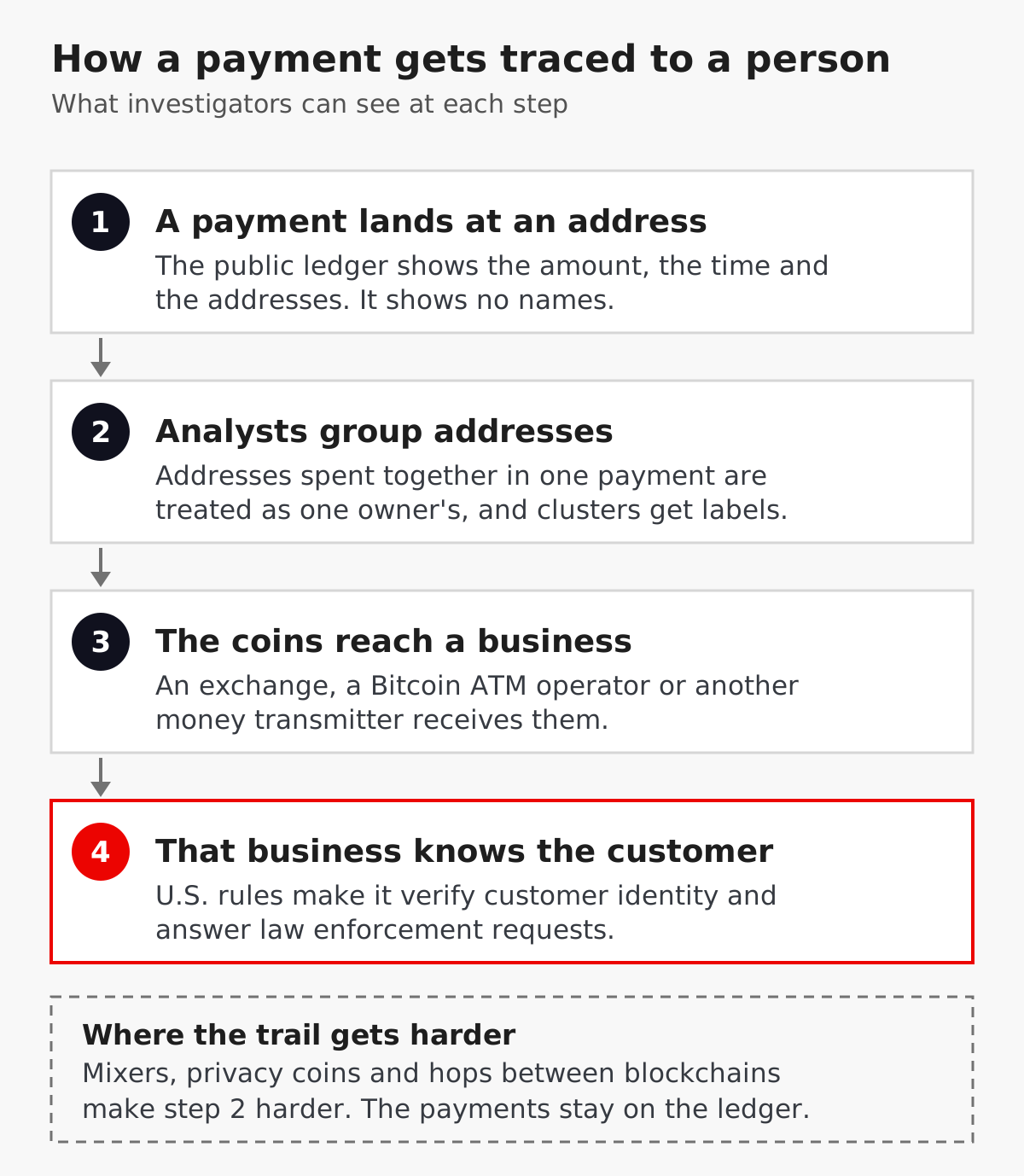
So bitcoin can be traced, though not the way many people assume. Every payment stays on that ledger for good, but the ledger records addresses, not names. An address usually leads to a person only where the coins meet a business that checked who its customer is.
How the FBI followed Colonial Pipeline’s ransom
Colonial was hit on or about May 7, 2021, took parts of its system out of operation and told the FBI it had paid DarkSide’s ransom demand, according to the department.
By reviewing the public ledger, agents tracked several transfers and found that about 63.7 of those bitcoin had landed at one address. The FBI held that address’s private key, which the department called “the rough equivalent of a password.”
The department did not say how the FBI got the key, or why the rest of the ransom was not recovered, TechTarget reported. The seizure clawed back $2.3 million of the $4.4 million Colonial had paid.

Deputy Attorney General Lisa Monaco thanked the company for calling the FBI quickly. “Following the money remains one of the most basic, yet powerful tools we have,” she said.
Every bitcoin payment sits on a public ledger
Bitcoin’s design requires every transaction to be announced publicly. Satoshi Nakamoto’s 2008 white paper said privacy would come instead from keeping the public keys anonymous, so outsiders could see an amount move from one party to another with nothing linking it to anyone.
The Federal Trade Commission tells consumers the same thing in plainer words: crypto transactions are typically recorded on a public ledger, and some information about yours will likely be public. ByteU’s guide to how Bitcoin transactions work shows what each record holds.
How analysts link one address to the next
The white paper also named the weak spot. A payment that spends coins from several addresses at once shows that one owner controlled all of them, and if that owner is ever identified, the link “could reveal other transactions that belonged to the same owner,” Nakamoto wrote.
Researchers at the University of California, San Diego built a method on that idea in 2013. They grouped addresses spent together into clusters, then put names on the clusters by making 344 transactions of their own with exchanges, wallet services, mining pools and shops.
Their paper concluded that “an agency with subpoena power would be well placed to identify who is paying money to whom.” Blockchain analytics firms such as Elliptic now sell this kind of tracing, along with labels for the addresses involved.
Can bitcoin be traced to a person? Usually at an exchange
“The blockchain shows us those wallets, but not who is behind them,” Elliptic wrote in its analysis of the Binance theft.
Names come from businesses. FinCEN, the Treasury’s financial crimes unit, said in May 2019 guidance that crypto businesses counted as money transmitters, exchanges among them, must run anti-money laundering programs that include verifying customer identification, keeping records and responding to law enforcement requests.
When traced coins land in an account at one of those businesses, investigators can ask who opened it. The same rules cover Bitcoin ATMs, since FinCEN treats a kiosk operator that swaps cash for crypto as a money transmitter. Byte Federal, which operates Bitcoin ATMs, says every transaction at every one of its machines requires identity verification regardless of amount.
Where the trail gets harder to follow
Some tools are built to break the trail. FinCEN describes mixers, also called tumblers, as services that take in crypto and send it back out in a way designed to keep anyone from tracing it to its source. It describes privacy coins as currencies engineered to prevent tracing on a public ledger.
The Binance theft shows how far a launderer can spread coins and how far analysts can still follow them. Since the Oct. 29 attack, the attacker has used more than 20,000 wallets on 16 blockchains and at least 36 services, made its first moves through six cross-chain bridges and put about 77 bitcoin through coinjoin mixing, Elliptic said in a Nov. 7 update. Its clients can screen nearly 18,000 addresses linked to the theft.
A trail can also stay readable for years. The people charged with laundering bitcoin stolen from the exchange Bitfinex in 2016 used fake identities, automated transactions and “chain hopping” into anonymity-enhanced currencies, prosecutors said.
Agents still seized more than 94,000 bitcoin, worth over $3.6 billion, after finding, in an online account, the private keys to the wallet that first received the stolen coins. The department announced the seizure in February 2022, and both defendants pleaded guilty in August 2023.
Tracing is not the same as getting money back
In the Colonial and Bitfinex cases, the government seized coins only once it held the private keys. Following a payment shows where the money went; it does not move it back.
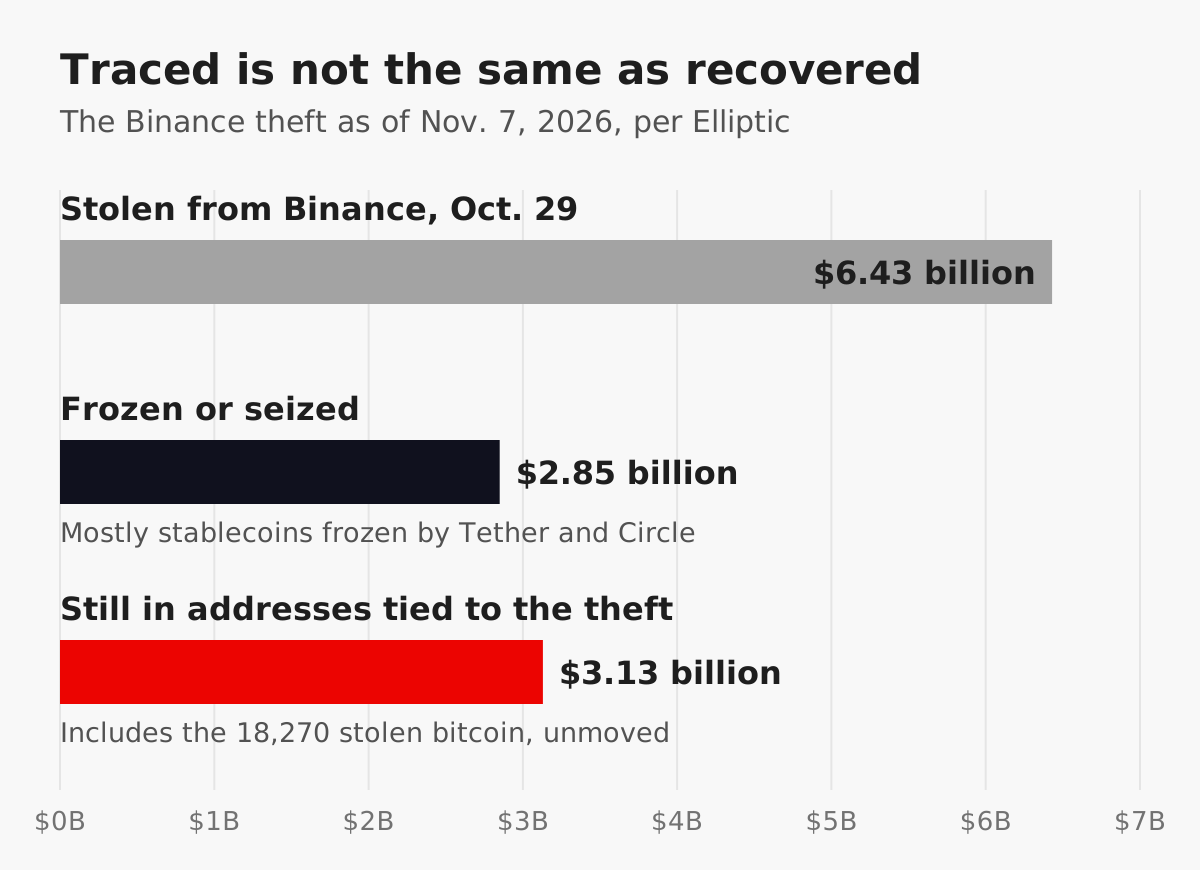
In the Binance case, most of what has been stopped so far was frozen by the companies that issue the tokens. Of the $6.43 billion Elliptic counts as stolen, $2.85 billion had been frozen or seized by Nov. 7, mostly stablecoins, tokens pegged to the dollar, frozen by Tether and Circle. About $3.13 billion still sat in addresses tied to the theft, and the 18,270 stolen bitcoin had not moved since the attacker split them across 19 addresses on the day of the attack.
The FTC warns that crypto payments typically are not reversible, and that you can usually get your money back only if the person you paid sends it back.
What to do if a scammer took your bitcoin
Report it fast. The FBI asks crypto scam victims to file at ic3.gov right away and to include the transaction details it calls the most important information:
- the cryptocurrency addresses involved
- the amount and type of cryptocurrency
- the date and time
- the transaction ID, also called the hash
- the exchanges you used to send or receive the funds
If you are missing those details, file anyway, the FBI says. The FTC takes reports at ReportFraud.ftc.gov and says to tell the exchange you used to send the money.
Treat any offer to trace and recover your coins with care. “Be wary of anyone claiming they can recover your funds as this may be another scam,” the FBI warns. ByteU’s guide to avoiding bitcoin scams covers the warning signs.
Elliptic expects the Binance attacker to need a centralized exchange or an over-the-counter broker to turn the remaining coins into cash. “That is where the funds can potentially be identified and stopped,” the firm said.
This article is for educational purposes only and is not financial advice.
Sources
- U.S. Department of Justice, “Department of Justice Seizes $2.3 Million in Cryptocurrency Paid to the Ransomware Extortionists Darkside,” June 7, 2021.
- TechTarget, “FBI seized Colonial Pipeline ransom using private key,” June 8, 2021.
- Satoshi Nakamoto, “Bitcoin: A Peer-to-Peer Electronic Cash System,” 2008, section 10.
- Federal Trade Commission, “What To Know About Cryptocurrency and Scams,” May 2022.
- Sarah Meiklejohn et al., University of California, San Diego, “A Fistful of Bitcoins: Characterizing Payments Among Men with No Names,” Internet Measurement Conference, October 2013.
- FinCEN, “Application of FinCEN’s Regulations to Certain Business Models Involving Convertible Virtual Currencies,” FIN-2019-G001, May 9, 2019.
- U.S. Department of Justice, “Two Arrested for Alleged Conspiracy to Launder $4.5 Billion in Stolen Cryptocurrency,” Feb. 8, 2022.
- IRS Criminal Investigation, “Bitfinex hacker and wife plead guilty to money laundering conspiracy involving billions in cryptocurrency,” Aug. 3, 2023.
- Elliptic, “How North Korea is laundering the $6.4 billion stolen from Binance,” Nov. 3, 2026, updated Nov. 7, 2026.
- Decrypt, “$3.1B in Stolen Binance Crypto Has Yet to Be Laundered: Elliptic,” Nov. 6, 2026.
- FBI Internet Crime Complaint Center, “FBI Guidance for Cryptocurrency Scam Victims,” Aug. 24, 2023.
Frequently asked questions
Can police trace bitcoin?
Yes. Investigators can read Bitcoin's public ledger. In June 2021 the Justice Department said agents had tracked transfers of Colonial Pipeline's ransom to one address and seized 63.7 bitcoin, worth about $2.3 million. Exchanges and other money transmitters must also answer law enforcement requests under FinCEN rules, which is how an address can lead to a name.
Can bitcoin be traced to a person?
Not from the ledger alone, which shows addresses and amounts but no names. The link to a person usually comes from a business that verified its customer's identity, such as an exchange or a Bitcoin ATM operator, once traced coins reach an account there.
Is bitcoin anonymous?
Not fully. Bitcoin's 2008 white paper says every transaction is announced publicly and privacy depends on keeping the owners of addresses unknown. It also warns that once one owner is identified, linked transactions can reveal that owner's other payments. Researchers and analytics firms use that linking to group addresses by owner.
Can stolen bitcoin be recovered?
Sometimes, but tracing alone does not bring it back. In the Colonial Pipeline and Bitfinex cases, the government seized coins once it held the private keys. The FTC says crypto payments typically are not reversible and you can usually get money back only if the person you paid sends it back.
What should I do if I sent bitcoin to a scammer?
File a report at ic3.gov right away, the FBI says, with the addresses, the amount, the date and time, the transaction ID and the exchanges you used. Also report it at ReportFraud.ftc.gov and to the exchange you sent from. Be wary of anyone who offers to recover your funds.
Topics in this guide
All topicsUse what you learned
Choose the Byte Federal product that fits your next step.